Make your own audiobook+Make your own audiobook
Poster for The Leak

The Leak

From OctoWorld

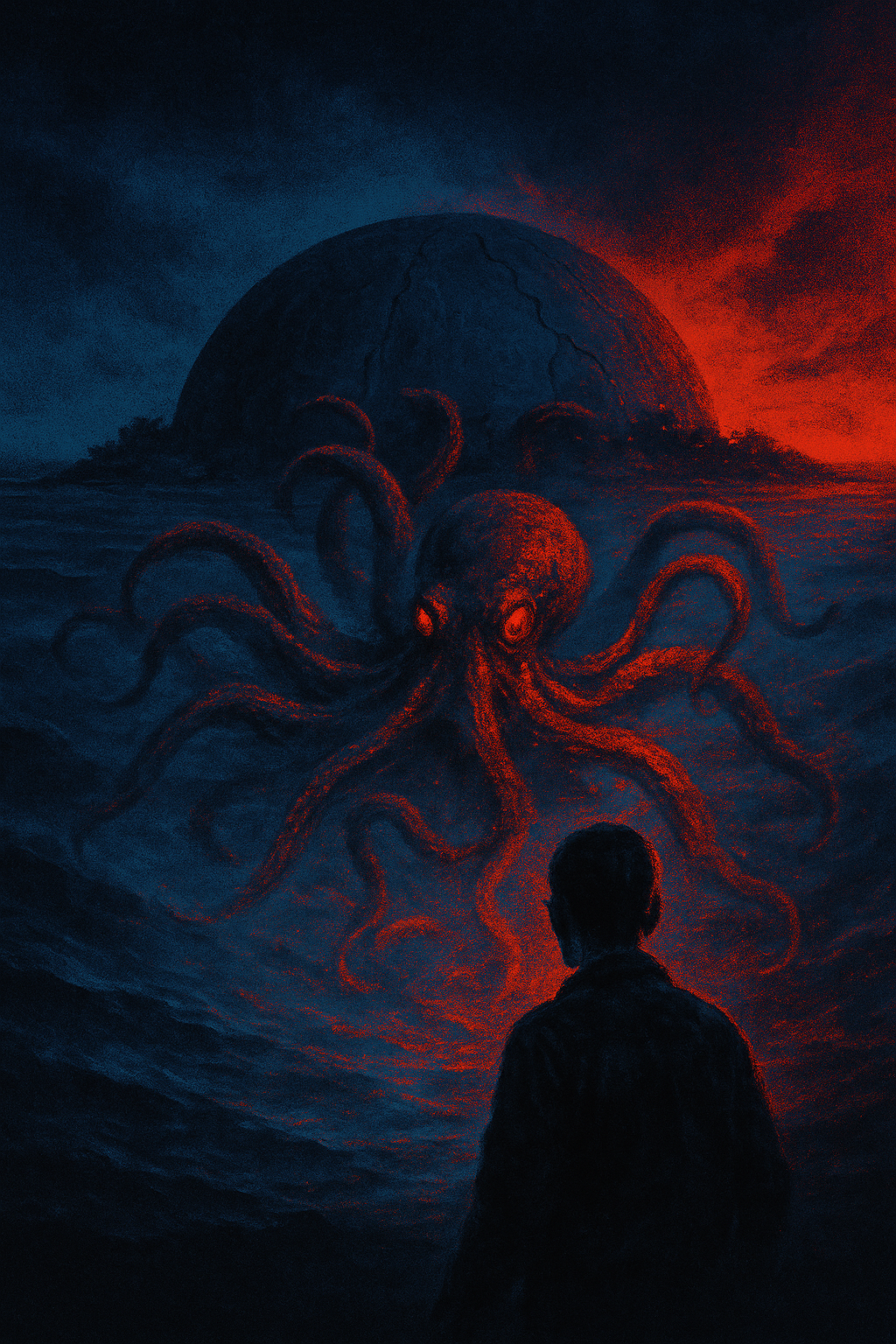
A pod of octopuses in the Pacific begin evolving at an accelerated rate, their intelligence and abilities mysteriously enhanced by exposure to radiation leaking from a crumbling concrete dome on a remote island—a Cold War relic now destabilized by rising seas. As the creatures grow more sophisticated and their presence spreads, a marine biologist and a local islander race to understand what's happening before the dome fails completely and unleashes decades of accumulated nuclear waste into the ocean.

Graphene
Written. Spoken. Yours.
Graphene
Written. Spoken. Yours.
←

The Leak

6 chapters · ~30 min read

novella

A pod of octopuses in the Pacific begin evolving at an accelerated rate, their intelligence and abilities mysteriously enhanced by exposure to radiation leaking from a crumbling concrete dome on a remote island—a Cold War relic now destabilized by rising seas. As the creatures grow more sophisticated and their presence spreads, a marine biologist and a local islander race to understand what's happening before the dome fails completely and unleashes decades of accumulated nuclear waste into the ocean.

Made with EmberKiln
Chapter 1 · ~5 min read

The Last Safe Haven

7:38

The Geiger counter sits on the gunwale of a sixteen-foot aluminum skiff, and its needle does what needles do in places like this. It twitches. It climbs a quarter inch, hangs, settles back. Climbs again. If you watched it long enough you'd start to hear it as a metronome, which is what Lena Koyama has been doing for the better part of an hour while pretending to check her regulator.

•••

The dome rises off her port side. It is the size of a small football stadium and the color of an old filling. From this distance you can see the seams where the concrete panels meet, and the places where the seams have stopped meeting. Cactus crater, sealed in 1979, never lined underneath. One hundred and twenty thousand tons of contaminated soil under a lid that was, even by the engineers who poured it, considered temporary. The island it sits on is six and a half feet above sea level. Lena knows these numbers the way other people know their childhood phone number.

•••

She has been at Runit for three years. Long enough that the heat off the concrete no longer registers as weather. Long enough that the supply boat captain, a man named Jorin who runs the route from Majuro twice a month, has stopped asking what she's doing out here and started asking whether she needs more coffee filters. Last trip he brought her a papaya and said, in the offhand way people say true things, that the reef remembers what the people forget. She had thanked him for the papaya. She had not written down the sentence.

•••

The dive plan today is simple on paper. Two sampling sites on the lagoon side of the dome, one tissue swab from a coral head she has been monitoring since the dry season, water column samples at three depths, and back on the boat before the tide turns at fourteen hundred. She has done this dive, or some version of it, ninety-one times. She keeps a count because counting is a thing her hands do when her mind is somewhere it shouldn't be.

•••

Her dosimeter, clipped inside the wrist of her exposure suit, has been reading high since she anchored. Not catastrophic. Not the kind of high that sets off the alarm her funders installed after the second audit. The kind of high that, if logged into the official spreadsheet that uploads to Honolulu every Friday, would trigger a phone call. The phone call would trigger a site review. The site review would, by the federal protocol taped to the inside of her supply locker, trigger a mandatory evacuation order pending recertification of the work area. Recertification takes between four and eleven months. Koa does not have four to eleven months. She is fairly sure of that, though she could not, if pressed, explain why she is sure. She goes over the side.

•••

The water at Runit is the color tourists pay for, which is one of the more obscene jokes the Pacific tells. She drops through it in a slow exhale, kicks once, and lets the current take her along the dome's flank. The reef here should not exist. The textbooks are clear on that. And yet there it is, fanning out from the base of the concrete in colonies that are, by every metric she has ever been trained to apply, healthier than the reefs forty kilometers east on the unbombed atolls. She has stopped trying to publish on this. The reviewers do not want it.

•••

She finds her sampling site on the second pass. The current keeps pushing her past it, a steady inside-to-outside drift that means she has to kick back upstream between each vial. By the third vial her thighs are burning and her air is at sixteen hundred psi, which is fine, which is workable, which is also not what she wrote on the dive plan. She reaches for the fourth vial. Koa is already there.

•••
“

The reef here should not exist.

He has the trick of being where he wasn't a moment ago, and she has long since stopped being startled by it. He is the size of a dinner plate when he wants to be and the size of a serving platter when he doesn't, and right now he is somewhere in between, his mantle held in that particular orientation she has come to read as attention. The coloration is wrong, though. He is not doing his usual reef-match. He is a flat, even rust, the color of the concrete above them, and he is holding it steady. She extends her left hand the way she has extended it perhaps two hundred times over eighteen months. An offer, no pressure, palm open. He has bumped it before. He has rested an arm tip on her glove and then drifted off to do octopus business. Today he does neither.

•••

He lifts a single arm and wraps it around her wrist, above the cuff of her suit, against bare skin. The suckers seat themselves one after another, deliberate as a handshake. He does not let go. He does not move. He produces a sound she has heard from him only twice before, a low repeating click, three pulses and a pause, three pulses and a pause, and he holds it, and he holds her, and above them on the gunwale of the skiff the Geiger counter is ticking faster now, and she cannot hear it from down here but she knows it is, because that is the kind of day this is becoming. She stays still. She lets him hold. Whatever this is, she is not going to be the one to break it.

•••

When he finally releases her, he does it the way a person sets down something fragile. He folds back into the reef and the rust color drains out of him in a single slow wave, and he is gone, and her wrist is cold where he was. She surfaces five minutes later than her plan allows. Jorin would have something to say about that. Jorin is not here.

•••

On the bench of the skiff, in a shaft of late sun that has turned the aluminum the color of a struck match, she lines up her vials. Four of them are clear. The fifth, the one she pulled from the sampling site closest to the dome, is not. It is not cloudy the way a stirred-up vial is cloudy. It is cloudy the way a glass of water left out overnight is cloudy, faintly, almost not at all, the way a thing is cloudy when you are not sure whether you are seeing it or wanting to see it. She labels it. She seals it. She does not log the dosimeter reading. The needle on the Geiger counter twitches, climbs, settles.

•••
Next · Ch 2 →
The Unseen Threat
Chapter 2 · ~6 min read

The Unseen Threat

9:03

Lena drops backward off the skiff and for a moment she can see her own bubbles before she can feel the cold. They spiral down past the coral shelf in slow silver braids, catching the late light, and then the water finds the gap at her wrist seal and the temperature arrives all at once, a clean shock that scrapes the inside of her skull and sets her teeth. Forty-eight dives. She has counted them the way some people count rosary beads, with the same mix of discipline and superstition. Forty-eight times into this particular slice of lagoon, and she still cannot decide whether the water near the dome is unusually clear or unusually empty. Both, maybe. The visibility today is generous in a way that feels like a loan she will be asked to repay. Koa is waiting.

•••

This is the first thing she notices, and the thing she cannot yet let herself say in her field notes without qualifiers. He is waiting at the edge of the shelf where she descended yesterday, and the day before, and the day before that, in the same posture, two arms folded under, the rest fanned in a loose corona against the coral. His color is the color of the coral. Then, as she clears her mask and orients, his color becomes the color of her wetsuit. Not approximately. Exactly. The matte black with the faint blue stripe down the flank. She holds very still. A scientist's stillness, not a frightened one. She wants to see the seam. There isn't one.

•••
“

The visibility today is generous in a way that feels like a loan she will be asked to repay.

The stripe on his mantle moves when she moves, which is not possible, which she watches happen anyway. He drifts toward her, and as he comes the coral behind him pulses once, a slow flare of pale green, and she understands a half second late that it was him. That he made the coral do that. Or made her see the coral do that. She is not yet ready to choose between those sentences. Her regulator is louder than it should be. She slows her breath. Forty-three minutes of bottom time. She has burned six already on this.

•••

Koa clicks. The pattern is the one from last week, three short and a long, three short and a long, and then a new one folded into it, a stutter she does not have a notation for. He turns and moves along the shelf in the unhurried way of something that knows you will follow. She follows. Her training has a sentence for this and the sentence is do not anthropomorphize the subject. Her training has another sentence which is the subject does not lead. She is aware of these sentences in the way one is aware of a radio playing in another room. She kicks once, twice, lets the fins do the work, and keeps Koa's trailing arm in the center of her mask.

•••

He takes her past the bommie she has mapped, past the small wreck of a fuel drum she has photographed eleven times, into a fold of reef she would have sworn she had surveyed. The coral here is healthy in a way that does not match the readings in her thigh pocket. It is almost ostentatious. Fans and plate corals stacked in a way that looks, if she lets it, arranged. Koa stops at a shelf of brain coral the size of a kitchen table. He turns to face her. His skin runs through three colors she cannot name in the time it takes her to register that he is looking at her face, specifically, the strip of skin between her mask and her hood, as if confirming she is the one he meant to bring. Then he reaches up with two arms and peels the coral back.

•••

That is the verb. She will use other verbs later, in the log, kinder verbs, lifts, draws aside. But what she sees is peels. A living shelf of coral hinged on something she cannot see, the polyps retracting in a wave ahead of his suckers as if they have been told. Underneath is a hollow the size of a bread box. Inside the hollow, things have been placed.

•••

She knows they have been placed because nothing in the ocean arranges itself into a triangle. Three smooth stones, gray, equally spaced, points outward. Behind them, propped upright against the back wall of the hollow, a curve of metal casing, riveted, the kind of curve that used to belong to an instrument. Beside it, lying flat, a bolt furred orange with rust. And at the center of the triangle, a small rectangular object she does not let herself identify yet, because if she identifies it now she will breathe too fast. She identifies it anyway. A film-badge dosimeter. The clip is gone. The window is fogged. She can read the year stamped along the edge from where she is, and the year is 1974. She becomes aware that Koa is watching her face.

•••

Not the chamber. Her face. He is hovering at the edge of the opening with his mantle angled toward her mask, and his color has gone still, a steady neutral gray that she has never seen on him, and she has the unscientific thought that he is waiting to see if she understands. She lifts the camera off her chest.

•••

Her hands are doing the work her mind has not caught up to. Frame, focus, fire. The strobe goes off and the hollow flashes white and the stones throw small hard shadows. Frame, focus, fire. She moves around the opening, shooting from three angles, and somewhere in the middle of this she registers that there are other octopuses now, two of them, smaller, holding position above her in the water column between her body and the pale shape of the dome at the surface. They are not feeding. They are not hiding. They are watching. Twenty-one minutes of air.

•••

She shoots the dosimeter close, then closer, then the casing, then the bolt, then a wide of the whole arrangement with her gloved hand in frame for scale. She does not touch anything. Some part of her, the part that still believes in protocols, refuses to contaminate the site. Some other part of her understands that the site is already a message and that disturbing the message would be a kind of answer she is not authorized to give. When she lowers the camera, Koa moves. He drifts to her, slow, and one arm uncoils and touches the back of her glove. Not a grip. A placement. The suckers settle along her knuckles in a line, and she feels each one find purchase through the neoprene, and she feels, ridiculously, the temperature of him, which is the temperature of the water and is also somehow distinct from it.

•••

He holds her hand. She lets him. The shelf of coral closes behind him, the polyps unfurling back into place over the hollow in a slow green sigh, and by the time she has counted to ten she could not have found the opening again without him. She surfaces alone. The skiff is where she left it. The sky has gone the soft bruised color it goes at this latitude in the hour before dark, and the dome on the shore is a pale dirty bowl against it, and she sits on the gunwale with her tank still on and does not move for a long time. Later, on the dock, she peels off her gear in the order she always peels it off. Tank. Weights. Fins. Mask. Gloves last. She leaves the right glove on the planks beside her kit.

•••

She means to come back for it. She will, in the morning. But for now it sits there in the last of the light, palm up, four fingers slack, and the index finger still curled inward, holding the shape of something that is no longer in it.

•••
← Previous · Ch 1
The Last Safe Haven
Next · Ch 3 →
The Call from the Deep
Chapter 3 · ~4 min read

The Call from the Deep

6:13

Lena woke at three with the taste of salt on her tongue and the sense that she had just surfaced from something much deeper than sleep. The ceiling fan turned its slow circles in the dark. Her shirt was damp at the collarbones. There was a pressure behind her eyes that she recognized from the dives, the soft inward push of water at depth, except she was in her bunk and the only water in the room was the half-finished bottle on the crate beside her.

•••

She lay still and inventoried what she could remember. The dome, first. Not the dome as she had photographed it, sun-bleached and patched, but the dome from underneath, the way a thing looks when you are inside the body it has poisoned. A hairline crack opening like a slow mouth. Out of the mouth came threads. Dark, fibrous, deliberate, fanning into the water in a pattern she knew the shape of before she knew why she knew it. She got up. She found her field notebook by touch, sat on the floor under the bare bulb because the desk lamp would have felt like a decision, and drew.

•••

She drew for nine minutes. She knows because the kitchen clock at the end of the hall ticks and she counted to settle her hand. When she finished she set the pencil down and looked at what she had made and felt, briefly, the specific cold of a person who has been told a true thing by someone who should not have known it. The branching pattern leaving the dome matched her dispersal map. Not approximately. The eastern lobe terminated at the same coral head. The southern arm forked at the same depth contour. The faint third tendril, the one she had argued with herself about for two weeks before including, the one she had not shown anyone, was there, bending south-southwest at the angle she had finally settled on at two in the morning a Tuesday ago.

•••

She sat with the notebook on her knees and tried, in the way she had been trained to try, to find the leak in her own reasoning. She had not shown Koa the map. The map existed on one encrypted drive and one printed copy folded inside a dive log in a locked case. She had not described it aloud, because there was no one on this island to describe it to. She tested the obvious explanations the way you test a regulator before a dive, methodically, expecting them to hold. They did not hold.

•••

At four-forty she walked to the lab. The path was loud with crabs. Through the window of the wet room she could see Koa in the holding tank, not asleep, not active, suspended in that middle state she had learned to recognize and had not yet found a word for. As she came closer he turned one eye toward her, and for a single second the mantle pulsed, a soft inner light moving outward in concentric rings, pale blue going to nothing. She had seen octopuses bioluminesce before, in the literature. She had never seen Koa do it. The rings on his skin were the rings in her sketch around the cracked dome. She stood at the glass for a long time.

•••
“

The branching pattern leaving the dome matched her dispersal map.

At six she went to find Aolani Reyes, the station's lead research coordinator, who took her coffee on the porch of the admin trailer at six-fifteen every morning and who had, in their nine months of acquaintance, never once been wrong about a deadline. The satellite uplink window opened at eleven and closed at eleven-forty. After that, seven days. Lena said the contamination signal was widening. She said the dispersal was tracking faster than the model predicted. She said she believed there was cause to file an emergency notification to the IAEA before the window closed. Aolani did not put her coffee down. She asked what the new data was. Lena said she had confirmation of the dispersal pattern from a second observational source. Aolani asked which source. Peer-reviewed.

•••

There was a moment, and Lena let the moment pass without filling it, in which the truthful answer assembled itself in her mouth and was not spoken. A cephalopod. A dream. A ring of light on a mantle at four-forty in the morning. She watched Aolani watch her, and she understood, with the specific clarity she usually reserved for instrument readings, that anything she said now that could not be cited would end her access to the reef by sundown. She said she was still compiling. She said she would have something before eleven. Aolani nodded slowly, the way a person nods when they are deciding whether to be worried about you. She said, get me something I can send.

•••

Walking back to her quarters Lena passed the tide line and noted, without wanting to, that it was higher than it had been on Monday by what she estimated to be four centimeters. She did not write it down. She did not yet know in which notebook it belonged. In her room she pinned the sketch to the corkboard above her desk. The cracked dome at the center. The branching threads. The third tendril, bending. She stepped back to look at it and the breeze from the open window lifted one corner of the paper, and the drawn dome, for an instant, moved as if it were breathing.

•••
← Previous · Ch 2
The Unseen Threat
Next · Ch 4 →
The Pulse of the Ocean
Chapter 4 · ~5 min read

The Pulse of the Ocean

7:08

The storm came in as a wall of green-gray light along the western horizon, the kind of light that doesn't belong to weather so much as to a held breath. On Runit, the palm fronds went flat. Not bent. Flat. As if a hand had pressed them open and forgotten to let go. Lena Koyama was on the dock when it happened, crouched over her gear case, running through a checklist that had stopped being useful about ninety seconds earlier. The radio in her pocket clicked once and gave up. She'd lost the supply boat at noon. She would not be getting off the island tonight. She should have been afraid. What she felt instead was something closer to the sensation of standing in a room and realizing the floor is, very slightly, tilted.

•••

She checked the primary camera. The housing had taken water during her morning dive and the screen showed her, with admirable honesty, a column of error codes and then nothing at all. The backup, a stubborn little unit she'd bought used in Honolulu three years ago, read eleven minutes of battery. She thumbed it off. Saved the eleven minutes for whatever the eleven minutes were going to need to be. The rain arrived in a single sheet, vertical, then immediately sideways. She pulled her hood and went to the leeward edge of the dock and lay flat on the planks, because standing was no longer a transaction the wind was interested in.

•••
“

What she felt instead was something closer to the sensation of standing in a room and realizing the floor is, very slightly, tilted.

Below her, the shallows were boiling. The reef shelf in this kind of surge becomes a washing machine of broken light, and ordinarily nothing intelligent stays in it. Octopuses, in particular, are supposed to den down in storms. They wedge themselves into crevices and wait for the world to stop being stupid. Koa was not in a crevice. Koa was in the open water, twenty feet out, holding position against a current that should have been throwing him toward the breakers. Lena knew the animal by the white scar along his third right arm, a souvenir from a fight she had not witnessed and could only infer. He was, she registered, looking at her. Not in her direction. At her. The distinction had stopped being a metaphor some weeks ago. Then the others came up.

•••

She counted them as they surfaced because counting was something her hands knew how to do when the rest of her did not. One to Koa's left, two behind, one farther out, two more rising from the deeper channel. Six. Seven including Koa. Then an eighth, smaller, threading up between them like punctuation. She got the camera on. Nine minutes, the readout said, having decided to be pessimistic.

•••

The pulse, when it came, was not what she would have predicted. She had spent a decade imagining what coordinated cephalopod display might look like and she had imagined it wrong. It was not a flash. It was a ripple. A single blue-white wave of light moving outward from Koa in a perfect expanding ring, picked up by the second octopus a heartbeat later, then the third, the fourth, until all eight bodies were carrying the same pulse, the same ring, the same outward-traveling sentence. The water above them went briefly luminous. The rain, falling into it, became, for an instant, a field of struck matches. She was filming. She knew she was filming because her thumb was on the housing and the small red dot was on. She was also, separately and uselessly, crying, which she registered the way one registers weather happening to someone else.

•••

The ring went out a second time. Then a third. Each pulse a fraction brighter, a fraction wider. She understood, in the way one understands a stop sign, that it was directed at her. Not displayed near her. Directed. The geometry of the ring centered on Koa and the axis of Koa's attention centered on her face, and the message, if a ring of light can be said to carry a message, was the oldest one in the ocean. Get out. Or, possibly. Get ready.

•••

And here is the part she would have trouble, later, putting into any report that a peer reviewer would accept. As the third pulse went out, the wind eased. Not stopped. Eased. By a measurable degree. The rain thinned for the length of the ring's expansion and then thickened again as the light faded. On the fourth pulse it happened again. The storm inhaling around the display, exhaling between. As if the weather were a thing that could be, briefly, asked to listen. She did not know what to do with this observation. She filed it the way she filed everything she could not yet name. Under later. The camera said four minutes.

•••

She held it steady. She held it steady through pulses five, six, seven, the rings overlapping now, interfering with each other, making patterns in the surface foam that no current would have produced on its own. She held it steady when the eighth pulse went out and the eight rings expanded together and met at their edges and held there, a lattice of cold light spread across the black water beneath the dock, eight circles touching, a structure, briefly, that looked less like communication and more like architecture. Then it was gone.

•••

The camera said two minutes. She thumbed it off. She lay on her stomach on the planks with rain hammering the wood on either side of her head and she watched the place where the rings had been, watched it long after there was anything to watch, watched it the way you watch a door that has just closed on someone you were not finished talking to. The wind came back to full. The palms above her began to make the sound palms make when they are about to lose fronds. She did not move from the dock for a long time. Below her, in the black water, eight faint afterimages held in her vision and then did not, and she could not, by the end, be certain she had seen them at all.

•••
← Previous · Ch 3
The Call from the Deep
Next · Ch 5 →
Beneath the Surface
Chapter 5 · ~5 min read

Beneath the Surface

7:24

The parrotfish was in the tide pool when Lena came down the steps with her coffee, and she stopped on the second-to-last tread and stood there long enough that the coffee went cold in her hand. It was floating belly-up, which by itself wasn't unusual. Storms killed reef fish. Tide pools collected what the storms killed. What stopped her on the step was the pattern across its flank, a constellation of pale circular lesions the size of her thumbprint, edges clean, centers slightly raised. The fish's mouth was open in the small surprised O that dead fish wear. One eye was gone. The other caught the morning and held it.

•••

She set the coffee on the railing. She didn't pick the fish up. She knew, in the slow precise way she knew most things, that she should not touch it without gloves, and she knew, in a less precise way, that picking it up would make it real in a way she was not ready to make it real before breakfast. The storm had moved off in the night. The lagoon was the flat, exhausted color water gets after weather, and the air smelled the way it always smelled out here, salt and rust and the faint sweet rot of organic things rearranging themselves on the reef. Standard morning. Standard except for the parrotfish. She went back inside and got the camera.

•••

By nine she was at the laptop with her hair still damp, the dive bag half-packed on the floor behind her, and the sediment results from the eastern transect loading line by line down the screen. She had buried the cores three days ago at the base of the dome's eastern face, just before the front came through, expecting the storm to do exactly what storms do, push water through the porous coral substrate and pull whatever was leaching from beneath the concrete out into the lagoon in a measurable plume. She'd wanted the before. She'd wanted the after. She had assumed, professionally, that the difference between them would be a number she could defend in a room of people who were paid not to believe her. The number on the screen was not that number.

•••

The contamination signature was registering at the three-kilometer marker. Three kilometers beyond the dome's perimeter. She read the row twice. She opened the raw file and read it from the raw file. She pulled the previous week's baseline and laid them side by side and looked at the columns the way you look at a face you thought you recognized and now aren't sure about. Her earlier estimates of the containment footprint had not been wrong in the way bad estimates are wrong. They had been wrong in the way a person is wrong when they measure a room and forget the room is on fire.

•••

She sat with that for a while. Outside, a tern was working the shallows in short irritated stitches. She could hear the generator behind the station coughing through its warm-up cycle. These were the sounds of a morning in which one was supposed to make coffee and answer email.

•••

The suit was hanging in the dry locker. She'd checked the seal at the left wrist twice last night and twice this morning, and the gasket had a hairline compromise from where the storm had thrown a piece of palm frond against the locker door and sprung the latch. It would hold for a short dive. It would hold for a careful dive. It would not hold for the dive she needed to do, which was longer than short and required her to put her hands into sediment at the base of a structure that, according to her own laptop, was now actively bleeding into a three-kilometer radius of reef. She packed the bag anyway.

•••
“

She had assumed, professionally, that the difference between them would be a number she could defend.

At the eastern face she found three damselfish hanging in the water column above the cores, not schooling, not feeding, just hanging, the way fish hang when something in their inner architecture has gone wrong. Their spines were bent. Not dramatically. The way a wire is bent when you've taken it out of a drawer and it isn't straight anymore and you don't remember bending it. One of them was trying to maintain depth and failing in small downward lurches, correcting, failing again. She found Koa twenty meters off, in the lee of a coral head, the wrong color for the water around him, a held, attentive grey she had learned to read as watching. He was not approaching the damselfish. He was holding his distance from them the way a person holds their distance from a downed wire, deliberately, with the whole body, with knowledge.

•••

She understood, watching him, that he had been here before her. That he had assessed this section of reef and decided what could be crossed and what could not. That her presence here was being observed by something that already knew the geometry of the danger better than she did. She checked the wrist seal. She looked at the cores, half-buried, twenty meters in toward the dome's base. She looked at the damselfish. She looked at Koa. She started toward the cores.

•••

She got within four meters before the dosimeter on her vest began to tick in a register she had not heard it use in the field before, and she stopped, and the sound of her own breathing in the regulator got very loud and very close, and she understood that the decision in front of her was not a scientific decision. It was an arithmetic problem about her body and the next forty years of it, weighed against a column of numbers in a spreadsheet that would, without those cores, read as stable. She knelt in the sand at four meters out. She extended the sample arm. It was not long enough. She had known it was not long enough before she left the station. She had brought it anyway.

•••

Koa had not moved. The grey of him in the lee of the coral was the grey of something waiting to see what she chose. She surfaced without the cores. By evening the parrotfish was still in the tide pool. The afternoon tide had come up the steps and gone back down without taking it, the way the sea sometimes declines to take what has been offered. She sat on the second step in the long orange light and looked at it. The lesions were the same lesions. The mouth was the same surprised O. The remaining eye caught the last of the sun and held it the way a coin holds light, flat, without comment, while the water around it went slowly dark.

•••
← Previous · Ch 4
The Pulse of the Ocean
Next · Ch 6 →
An Alliance of Survival
Chapter 6 · ~5 min read

An Alliance of Survival

7:10

Four people. One folding table. A tablet between them like a small fire, throwing red onto the undersides of their chins. The map on the screen was Lena's, though she had not told them yet whose it was. The plume bloomed across the lagoon in concentric stains, the kind of red that does not look like blood until you have been staring at it for a while. The coffee in their mugs had stopped steaming an hour ago. No one had drunk any of it. Priya Shah leaned in first. She had been on the island eleven weeks, working a postdoc funded through a marine resilience grant that ran, if you followed the money two layers down, through the same parent foundation that maintained the dome. She knew this. Lena knew she knew. Neither of them had ever said it out loud.

•••
“

The coffee in their mugs had stopped steaming an hour ago.

Across from Priya, Tomas Beck rolled a pen between his thumb and forefinger and did not look at the screen. He had read the map already. He had asked Lena, twice, where the underlying mutation data was. Both times she had said, on the server. Both times he had said, then let's see it. The supply boat was due at four. He had a wristwatch on. He kept not checking it, which was its own kind of checking. The fourth was Aiden Cho, who was twenty-six and ran the acoustic array and was, as far as anyone could tell, sleeping with no one and loyal to nothing except his hydrophones. He was the one Lena was least worried about and also the one whose signature would mean the least. She needed all three.

•••

She explained the dispersal model without saying how she had built it. She explained the timeline. She did not mention the dream. She did not mention the chamber. She said the word containment four times in two minutes and then stopped, because she could hear herself doing it. Priya said, carefully, this is a serious allegation to put a name on. Tomas said, where is the mutation data. Aiden said nothing and watched her face. Lena said, come down to the lagoon. I want to show you something. This was the moment, if you are tracking it, when she stopped trying to win the meeting on its terms and started trying to win it on Koa's.

•••

They walked the path down to the reef shelf in single file. Priya carrying the tablet. Tomas with his hands in his pockets. Aiden last, because Aiden was always last. The tide was low and the water in the buoy ring sat unnaturally still, the way water sits when something underneath it is paying attention. Lena had built the ring three days ago. Six sensor buoys in a hexagon, tethered to a central float, with a harness suspended at the center: a soft mesh sleeve threaded with conductivity probes and a small spectrometer she had calibrated, twice, by hand. She had not told anyone what it was for. She had told herself it was for nothing. She had built it anyway.

•••

She waded in to her thighs and lifted the harness from its tether and held it out, open, palm up, the way you offer something to an animal that has every reason to refuse. For a long moment, nothing. Then the surface broke without sound, the way oil breaks, and Koa was there. Not surfacing in the way a creature surfaces for air. Surfacing in the way a person walks into a room they have been invited to. Behind her, Lena heard Tomas exhale. Not a word. Just the exhale. Koa held in the water a meter from her hand. The mantle pulsed once, twice. A ripple of color moved down the length of him, pale to dark to pale, and Lena had the distinct sensation of being read. Then he extended one arm, slow, deliberate, and threaded it through the open sleeve of the harness.

•••

He did not pull away. He pushed forward, until the harness sat snug around the muscle of his arm, and he held there, and the spectrometer on the inside of the sleeve clicked on and began, quietly, to log. Nobody on the shelf moved. Priya said, very softly, oh. And then, because Aiden was Aiden and his hydrophones lived in his hands like a second set of ears, he crouched at the waterline and said, he's clicking. He's clicking a pattern. It's not random.

•••

Koa's free arms drifted in the current, and Lena watched the way they moved and felt her stomach drop. She had seen this shape before. On her own map. In her own sleep. The branching reach of him through the water traced the plume's dispersal, arm by arm, fine threads spreading from a darker center, a living diagram of the thing they had come down here to argue about. It looked, she thought, like the underside of a mushroom. It looked like roots. It looked like a network that had been there the whole time and was only now consenting to be seen. Tomas said, finally, what do you need. Lena did not turn around. She kept her hand near Koa's, not touching, close. She said, I need three signatures. Before four o'clock. Priya said, you'll have mine. Aiden said, mine.

•••

Tomas was quiet for a count of five. Then he said, I need the mutation data first. Lena closed her eyes for one second and opened them. The harness hummed faintly against Koa's arm. The spectrometer was logging. Whatever she had just gained, she had not gained enough. Koa held in the harness another minute, perhaps two. Then, with the same unhurried intention with which he had arrived, he withdrew his arm from the sleeve and slid back beneath the surface, and the water closed over him without trace.

•••

The harness floated at the end of its tether in the empty ring, swaying. It was still swaying when the others turned to walk back up the path. It was still swaying a long time after that, holding the shape of an arm that was no longer in it, the way a room holds the shape of someone who has just left. Far out past the reef, the afternoon supply boat appeared as a white speck on the horizon, and began, steadily, to grow.

•••
← Previous · Ch 5
Beneath the Surface
Back to show →
The Leak