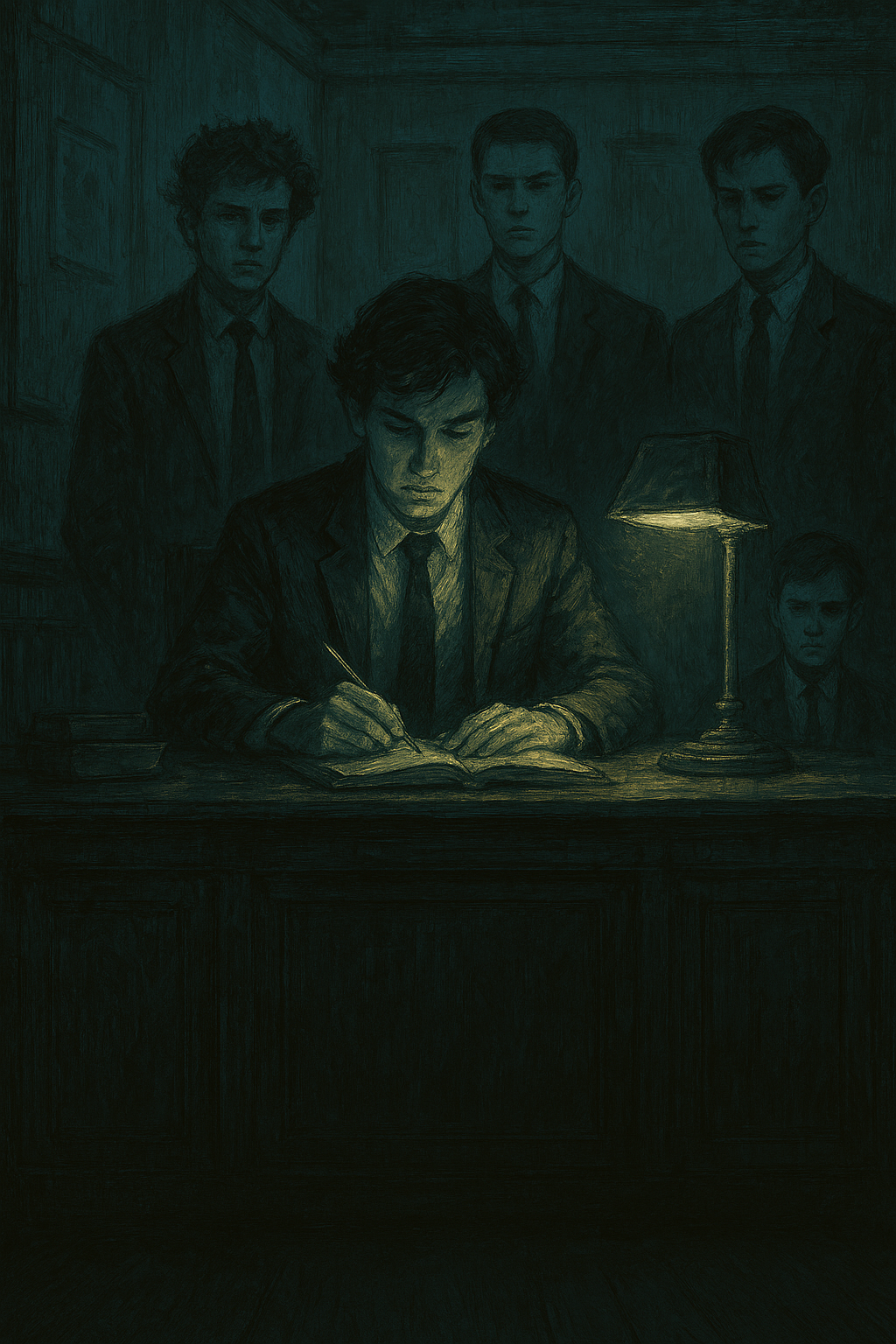
Whispers in the Dark
The torch was the kind they kept in the supply closet for fire drills, rubber-handled, heavier than it looked, and at seven minutes past nine on a Tuesday in October it was the only working light in the east wing of St. Ignatius. Marcus Chen had set it on its base, upright, so the beam threw a trembling cone against the ceiling and washed back down across twelve boys in varying postures of not-quite-sitting.
The fluorescent hum was gone. That was the first thing he had noticed, more than the dark. The building made a sound when it was working, a low electrical breath you stopped hearing after your first week as a boarder, and when it cut out you heard the absence before you understood what had happened. Then the corridor lights had stuttered and held for a moment at half-strength, the colour of weak tea, and then they had gone too.
The prefect office was wood-panelled, narrow, lined on three sides with the framed photographs of head boys going back to a year Marcus could not read from where he was sitting. On the fourth wall, behind his shoulder, a clock had stopped. He had not looked at it. He knew it had stopped because nothing in the room was moving except the boys, and the second hand was not part of what he could hear. He opened the register. He did not need the register. He opened it because opening it was a thing prefects did, and the sound of the cover hitting the desk was a sound the room recognised. "I'll be reading names," he said. "You'll respond when called. We'll wait here until staff confirm the all-clear. By the book."
His voice arrived a half-beat before he did. It was not exactly his voice. It was a voice he had been issued, two years ago, along with the badge and the second-floor room and the key that opened this door and no others. He had practised it in the mirror over the dormitory sinks until it stopped sounding like a borrowed coat. "Ashworth." "Here." "Bell." "Here." The smallest boys were the easiest. They had the habit of answering in classrooms, and a roll call sounded enough like a classroom to do the work for him. He moved through the second-years with the cone of light over his shoulder and the pen in his hand making a small dry scrape against the paper, which was a sound he liked, which was the sound of something getting done. It was in the third-years that the room began to lean.
Not loudly. A boy near the window had turned in his chair so that he was facing another boy at an angle the chair had not been designed for. Someone behind him was breathing through his nose in a way that meant he was about to laugh. There was a whisper, two rows back, which stopped when Marcus's pen stopped, and resumed when it started again, slightly louder, as if the whisper were measuring him. "Wexford." Callum Wexford stood up. He did not say anything at first. He was a tall boy for fifteen, and he stood the way boys stand when they have never been hit by an adult, with his weight even on both feet and a small smile that was already deciding what the next thing would be. "Sit down," Marcus said. "I need the toilet." "Sit down, Wexford." "It's an emergency."
The smile widened by a fraction. Marcus felt the room turn its head, very slightly, like an animal noticing weather. He understood, with a clarity that surprised him, that there was no script for this. The intercom on the wall was a piece of beige plastic. The camera in the upper corner was a piece of glass with nothing behind it. The protocols were taped to the inside of a cupboard he could not see in this light. He had a torch, a register, and a voice that was not quite his. A hand went up in the second row. A second-year, one of the quiet ones, whose name Marcus had called four minutes ago and could not now remember.
"Sir," the boy said, which was the wrong word, prefects were not sirs, but the boy had said it like a question and not a mistake. "Could we just wait. Please. Until the lights." It was not addressed to Callum. It was addressed to the room, and to Marcus, and to the situation, as if the situation were a fourth presence that could be reasoned with. Callum's smile faltered. Not much. Enough. Marcus closed the register. The cover came down harder than he meant, and the sound of it carried, and the room went still in a way that felt, for a moment, like obedience. He looked up.
Most of the boys were looking at the desk, or the floor, or the dim shape of the door. One boy in the back row was looking at him. Marcus did not know his name. The boy did not look away when their eyes met, and he did not look away when Marcus held the look longer than was comfortable, and he did not look away when Marcus finally, deliberately, returned to the register and pretended to find his place. "Wexford," Marcus said. "Sit." Callum sat. Marcus let out a breath he had not been keeping track of. He reached for the torch to angle it more usefully across the page, and his hand met the rubber grip, and the rubber grip, which had been balanced on a base designed for a slightly different model, rolled.
It rolled an inch. It rolled another inch. It went off the edge of the desk with the unhurried certainty of an object that had been waiting all evening to do exactly this, and it hit the floor, and the bulb, which was old, went out. The dark, when it came, was complete. Not the dark of a room with curtains. The dark of a room with no light at all, in a building with no light at all, on a corridor with no light at all, at the centre of a school whose generator had not, it seemed, been tested in some time. For one second Marcus heard nothing. For the second second he heard twelve boys breathing, and understood that he could not tell which breath belonged to Callum and which belonged to the boy in the back row.
The third second was the longest. At the end of it, somewhere to his left, a chair leg moved against the floor.