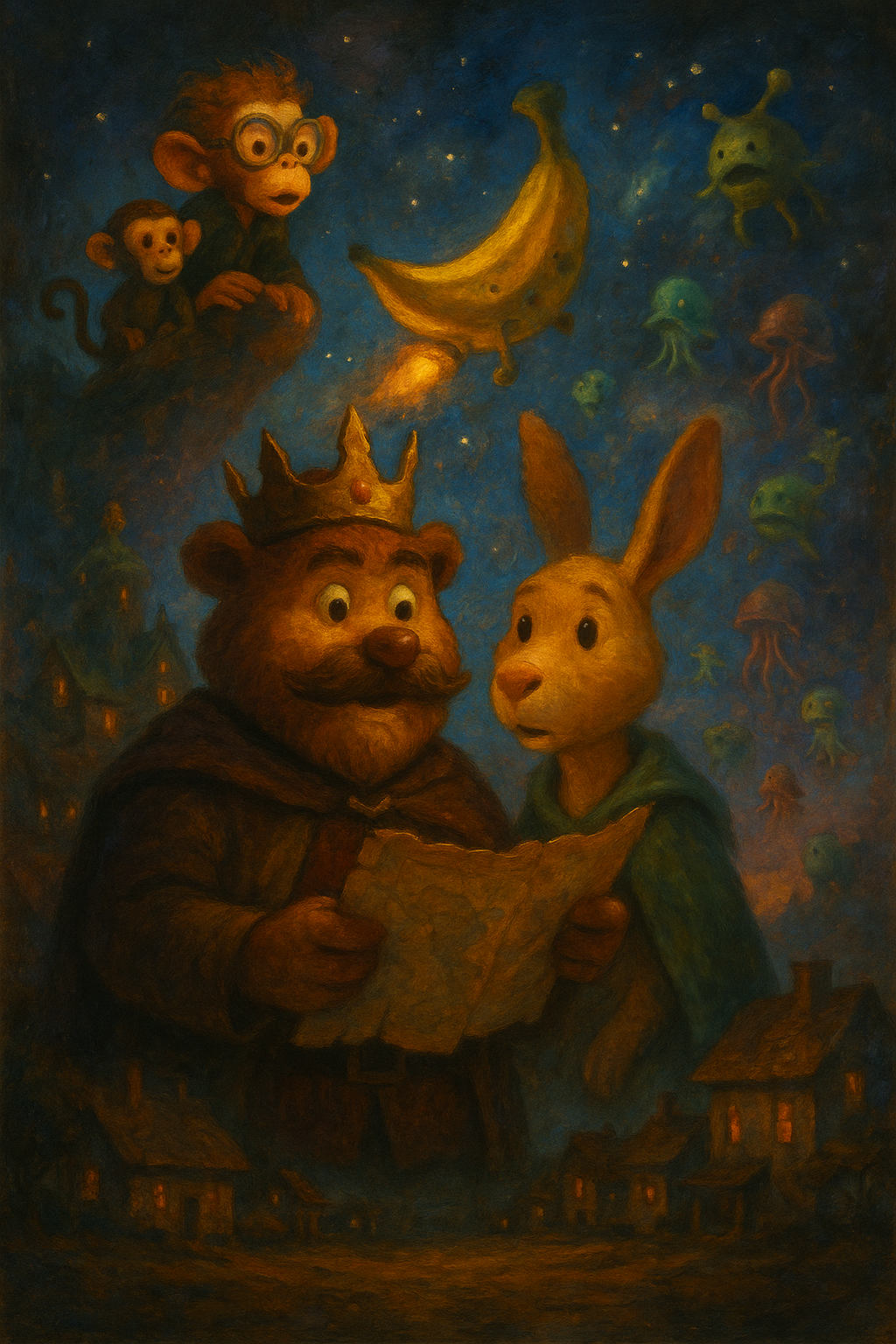
The Map in the Mud Puddle
The puddle is the size of a wagon wheel and still trembling from the last fat raindrop when King Ted steps directly into the center of it. Not the edge. Not the slightly raised stone he had a clean shot at. The center. His left boot sinks until the mud closes brown and patient around his ankle, and he says, with the particular dignity of a man whose crown has slipped slightly forward over one eye, "Ah. Yes. I meant to do that." No one in the forest believes him, including the forest.
Bellyroo, three paces behind, makes the small chuffing noise that, in Bellyroo, passes for laughter. Bellyroo is roughly the height of a tall child and roughly the shape of a small barrel with opinions, and Bellyroo's pouch, slung across the chest like a satchel, sloshes audibly with each hop. It sloshes because it contains, at present, a spoon, two acorns of suspicious origin, a length of green ribbon, a pebble Bellyroo is fond of for reasons Bellyroo has never explained, and a small jar of something that was once jam and is now closer to a hobby. We will, in time, come to know that pouch better than we know some of our cousins. For now: it sloshes. "You could just go around," Bellyroo offers. "A king," says Ted, attempting to extract his boot, "does not go around." "A king," Bellyroo says, "is standing in a puddle."
Ted concedes the point with the grace of a man who has no choice. He plants one hand on his knee, leans, pulls. The boot comes free with a noise like the forest clearing its throat. Mud spatters his cloak. The crown slips further. And it is precisely at that moment, in that ungainly half crouch, that Ted notices the gleam. It is not the gleam of a coin. Coins gleam silver or gold or, in the cheaper sort of kingdom, suggestion. This gleam is wrong for any of those. It is faintly warm in color, the way a window looks from outside on a cold evening. And it is under the mud. "Bellyroo," Ted says quietly. "Come look at this."
Bellyroo hops over and peers down. The two of them squat at the edge of the puddle like men reading bad news in a newspaper. Ted reaches in. His fingers close on something papery, which should be impossible, because paper does not survive a forest puddle, and yet here it is, intact, when he draws it up. He rinses it as best he can in the cleaner water at the puddle's edge. Mud sloughs off in dark ribbons.
What's left is a square of something that is almost paper and almost not. It is the color of cream left out too long. There are markings on it, faint, brown, careful. And it is, Ted realizes as he holds it between his palms, warm. Not the warmth of a thing that has been sitting in the sun. The sun has not been out in two days. The warmth of a thing with its own opinion about temperature. "Huh," says Ted. "That's not a puddle thing," Bellyroo says, which is, in its way, a complete and accurate review. Ted turns it. The markings do not resolve into anything he recognizes. There is a shape that might be a coastline, or might be a sleeping animal, or might be a smear. He squints. He tilts. The lines slide under his attention, which is unusual behavior for lines.
Above them, the clouds, which have been a single gray ceiling all morning, part. Not dramatically. Just enough. A pale shaft of light finds the path, finds Ted's muddy boot, finds the back of his hand. He does what a more cautious man would not do. He lifts the map into the light. The paper, if it is paper, warms further against his palms. The brown lines flare gold. They go on flaring, slow and steady, the way a coal does when you breathe on it, until the whole square is glowing in his hands like a held candle, and the shape that was almost a coastline is suddenly, unmistakably, a coastline. An island. A familiar one. The little hook of its northern cape. The two bays. The cluster of hills at the center where the old stones lean. "That's home," Ted says.
"That's home," Bellyroo agrees, in the voice of someone who has just seen their kitchen on a stranger's wall. But it is not only home. Ted tilts the map, and the glow shifts, and beneath the inked outline of the island, beneath it, where there should be sea or the back of the paper or nothing at all, there are points of light. Small. Scattered. Cold and silver in a way the rest of the map is warm and gold. They are arranged the way stars are arranged, which is to say, not arranged at all, and yet looking right. The island is floating in them. Ted opens his mouth. Closes it. The glow at the edges of the map is already beginning to dim, retreating inward like a tide. "Bellyroo," he says, "the root. The dry one. Quickly."
Bellyroo hops to a thick root arching out of the bank, scrubs it with one paw, and Ted lays the map flat between them. They crouch over it shoulder to shoulder, the king with one muddy boot and his crown askew, the companion with a sloshing pouch and very round eyes, and they watch. The gold pulls in further. The coastline holds. Below it, in that impossible dark, the little silver stars pulse once, together, like something taking a breath. And then they hold. Neither Ted nor Bellyroo speaks for a long moment. Somewhere up the path, a last drop falls from a leaf and finds the puddle, and the puddle, having done its work for the day, accepts it without comment. "Well," Bellyroo says finally, very quietly. "That's not a puddle thing at all." Ted does not answer. He is still looking at the stars under his island.