Make your own audiobook+Make your own audiobook
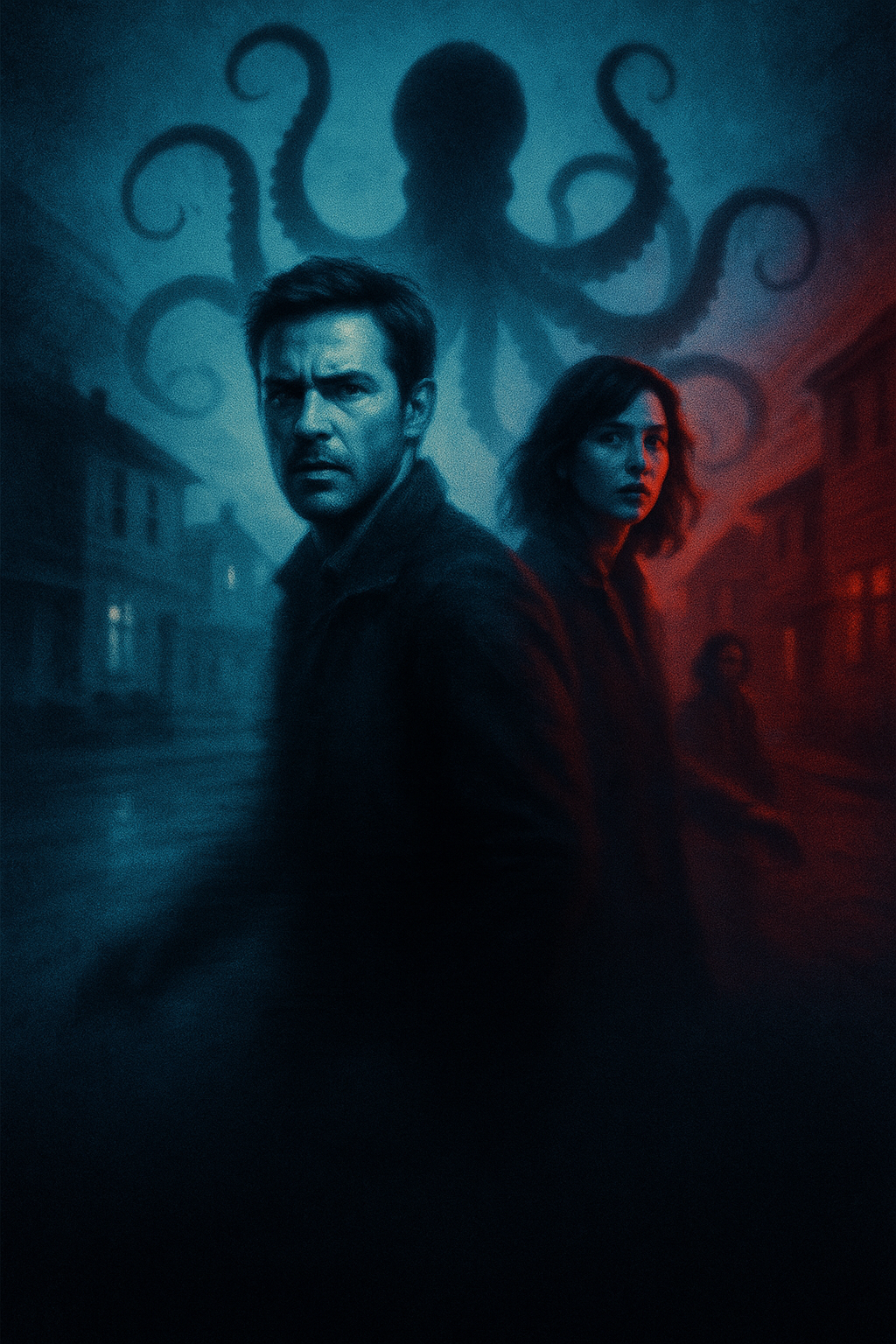
Poster for Whispers of the Deep

Whispers of the Deep

From OctoWorld

Wesley Carter confronts a rogue faction of scientists aiming to sever the delicate bonds between humans and octopuses, as Marina Lopez races against time to prevent a catastrophic war against the ancient cephalopod sages. Together, they embark on a perilous journey through the shimmering depths, uncovering secrets that could either solidify their alliance or tear their world apart forever. With silhouettes of entwined tentacles guiding them, they must navigate the thin line between loyalty and betrayal.

Graphene
Written. Spoken. Yours.
Graphene
Written. Spoken. Yours.
←

Whispers of the Deep

4 chapters · ~17 min read

novella

Wesley Carter confronts a rogue faction of scientists aiming to sever the delicate bonds between humans and octopuses, as Marina Lopez races against time to prevent a catastrophic war against the ancient cephalopod sages. Together, they embark on a perilous journey through the shimmering depths, uncovering secrets that could either solidify their alliance or tear their world apart forever. With silhouettes of entwined tentacles guiding them, they must navigate the thin line between loyalty and betrayal.

Chapter 1 · ~4 min read

The Depths of Knowledge

5:19

Fifty feet down, Wesley Carter let his gloved hand drift through the water the way a person might trail their fingers from a slow-moving boat. He was forty-two years old. He had been diving since he was twelve. He had, by his own count, logged something north of four thousand hours below the surface, and he still did this. Still let his hand open into the current and feel it pass through his fingers like a thought he was almost having.

•••

The pressure gauge on his wrist held steady. Visibility, generous. The reef below him, a sector that until last quarter had existed on his charts only as a smear of unsurveyed blue, opened in slow tiers of coral and shadow. He had ninety minutes of bottom time, a sampling kit clipped to his hip, and a protocol he had written himself, which is to say he had no excuse for deviation. Three meters ahead, an octopus hung in the water and watched him.

•••

Wesley stopped finning. He had seen a great many octopuses in his life. He had, in fact, built a career on the proposition that they were worth seeing, that the small, soft, eight-armed intelligences of the reef were worth a serious person's serious attention. He was the kind of marine biologist who used the word colleague about them when he thought no one was listening. So he knew, in the way you know the face of someone you love, that this was wrong. The animal was not hunting. It was not fleeing. It was not, so far as he could tell, doing any of the things octopuses do when they hold still in open water, which is to say it was not pretending to be something else. It was simply present, suspended in the column at a depth that cost it effort to maintain, and its skin was moving.

•••
“

Three meters ahead, an octopus hung in the water and watched him.

The chromatophores cycled. Not the fast, conversational flicker of mood, not the banded ripple of threat display. Something steadier. A pattern that resolved and dissolved and resolved again, in intervals Wesley found himself, against his training, beginning to count. He lifted his camera. The animal did not flinch. He took the photograph. The strobe lit the water white for an instant, and in that instant the octopus's eye, the slotted, unreadable pupil of it, was aimed directly at his mask.

•••

Wesley exhaled. A column of bubbles climbed past his faceplate and broke apart on the way to a surface he could no longer quite see. He reminded himself of the sampling kit. He reminded himself of the dive window. He reminded himself that wonder, in his profession, was a tax you paid on the way to data, and that the data was what kept the lights on, and the lights were what kept him diving, and so on, in the small closed circuit of a working life. He turned, slowly, to resume his transect. The second octopus was not watching him. The second octopus was dead.

•••

It lay on the seafloor at the base of a coral head, arms arranged in a way arms do not arrange themselves, and it was held there. A thin rod, no thicker than a pencil, ran through the mantle and into the substrate. Wesley sank to it. He had spent enough time around laboratory hardware to recognize titanium when he saw it, and he had spent enough time signing requisition forms to recognize the stamp on the rod's collar before his mind had finished forming the word for what he was looking at. He knew the serial prefix. He knew the institution that ordered under it. He knew, because he had signed for a case of these rods himself, eleven months ago, for a vibration study that had used precisely four of them and returned the rest to inventory.

•••

He did not move for a long moment. His regulator clicked. Somewhere above and behind him, a parrotfish made the dry sound of a parrotfish eating coral, which was the sound of the reef being, as it had always been, itself. He took the photograph. He took another, wider, with the coral head in frame for scale. He took a third of the rod's stamp, close enough that the numerals would be legible to anyone who knew where to look, and he made himself, with a discipline he was proud of and did not examine, take a fourth. Then he turned back to the octopus that had been watching him. It was gone.

•••

Where it had hovered, the silt on the seafloor below held eight shallow impressions, evenly spaced, arranged in the soft radial geometry of a creature that had, at some point in the last several seconds, set itself down and then lifted away again. The current was already at work on them. The edges were softening. In another minute they would be nothing at all, and Wesley would be a man underwater with two photographs and a story no one had to believe. He hung there above the prints and watched them fill. His dive computer chimed. Forty minutes to window's close. The sampling kit at his hip, untouched, weighed exactly what it had weighed at the surface, and somehow more.

•••
Next · Ch 2 →
The First Tentacle
Chapter 2 · ~4 min read

The First Tentacle

5:52

At three in the morning, the translation monitor was the only source of light in the room, and it was the color of bourbon. It threw amber across Marina's face, across the back of her left hand where she had been resting her chin for so long that there was a faint mark from her knuckle, across the rim of a coffee mug she had refilled twice and forgotten twice. In the corner, the specimen tank kept up its low gurgle, a sound she had stopped hearing the way you stop hearing a refrigerator. The room smelled of cold coffee and brine and the particular ozone tang of a hard drive that had been running too long.

•••

She had been at this for nine hours. Marina is twenty-nine and has spent six of her professional years arguing, mostly in rooms where people were polite about disagreeing, that other species are not metaphor. She is good at the argument. She has lost it often. On the screen, the chromatophore sequence from Wesley's footage played in a slow loop she had built herself, frame by frame, against a sidebar of pigment-state notations that no journal had ever published because no journal had been asked to. The pattern was not random. She had known it was not random within the first twenty minutes. What had taken the other eight hours and forty minutes was admitting to herself what it was instead. It was syntax.

•••

She printed the translation at 3:14 a.m. The printer was old and made a sound like someone clearing their throat. She did not read the page again. She had read it enough. Wesley arrived at 3:31, which was faster than she expected from a man she had called and given only the words I have something. He came in still wearing the fleece he must have slept in, his hair pressed flat on one side. Wesley Carter is forty-two, an INTJ who keeps a spreadsheet of his own dive hours and has never, on record, used the word feel in a peer-reviewed paper. He stood in the doorway for a moment and looked at the tank instead of her, which she understood. The tank was easier. She poured him coffee from the pot he would not drink and slid the translation across the table.

•••
“

She had known it was not random within the first twenty minutes.

He reached for it. His hand stopped about two inches from the page. She watched that. She watched the stop. It was not the hesitation of a man who didn't know what he was looking at. It was the other kind. The kind where the body arrives at the answer before the eyes do. "Read it," she said. Her voice was not the voice she used in lectures. It was quieter and had more of her in it. He read it. He read it twice. She knew because she counted the small movement of his eyes back to the top of the page. "Six days," he said. "Six days from the date stamp on your footage. So five, now. A little less."

•••

He set the page down very carefully, the way you set down something that might be evidence. "And this phrase here." He turned the paper around without lifting it and pointed. He did not say the phrase aloud. Neither of them had, yet. The translation rendered it as when we worked alongside you before, though Marina had spent an hour on that verb and was not satisfied with alongside. Alongside was the closest English had. The original implied something more like inside the same task. "I don't know," Marina said. "I don't know what it refers to. I don't have a framework for it. There isn't one." "There isn't one yet," Wesley said, and she noticed the yet, and filed it.

•••

He stood up. He walked to the tank, put one hand flat against the glass without touching it, just held it there a centimeter off. The octopus inside, a small one, a juvenile she had been keeping for entirely unrelated reasons, drifted toward the hand and stopped, considering. Its skin moved through three colors Marina could name and one she could not. Wesley watched it for a long time. "If I bring this to the committee," he said, without turning around, "they will ask me to verify it independently. That will take eight weeks. Minimum." "I know." "And if I don't bring it to the committee." He did not finish the sentence. He didn't need to. She had been thinking about the end of that sentence since 3:14.

•••

He came back to the table. He sat down. He reached into his pocket and took out his keycard, the one with the magnetic strip that opened the lower levels, the ones she had never been cleared for, the ones whose existence she was technically not supposed to know about. He set it on the table between them, face-down, the way a person sets down a card in a game where the rules have not yet been agreed on. He did not push it toward her. He did not take his hand away from it immediately, either. He left his fingers resting on the back of it for a moment, then withdrew them. Neither of them spoke. The specimen tank gurgled. The printer, finished, made a small mechanical sigh as it powered down. Somewhere in the building a ventilation system cycled on, then off.

•••

Marina looked at the keycard. Wesley looked at the translation. The keycard stayed where he had put it. Twenty minutes passed that way, and then another five, and the amber light on the monitor shifted by one degree as the loop began again, and neither of them had reached for it yet.

•••
← Previous · Ch 1
The Depths of Knowledge
Next · Ch 3 →
Shadows in the Abyss
Chapter 3 · ~5 min read

Shadows in the Abyss

7:11

The submersible's lights cut a narrow wedge through the water, and inside that wedge: glass. A row of tanks, eight that they could count, lit from beneath by a pale green that didn't look like any luminescence Wesley had a name for. Each tank held one octopus. Each octopus was pressed flat against the inward-facing wall, arms splayed, mantle motionless. Not resting. Not hiding. Arranged. Wesley had spent twenty years cataloging cephalopod posture. He could read a sulk from a stalk, distinguish a hunting crouch from a sleeping curl. He had no vocabulary for what he was looking at. He said so, quietly, into the cabin recorder, because the cabin recorder was the only thing still recording anything useful.

•••

Marina was already at the porthole. She had the small black notebook open on her knee, the one she used when she didn't trust the digital log, and she was drawing the tanks before she spoke about them. This was a habit Wesley had noticed and not yet asked about. She drew first. She named things second. "Eight," she said. "All the same species?" "All Octopus vulgaris. All female, from the mantle proportions. All adult." He paused. "All in the same posture." "Octopuses don't do that." "No."

•••
“

He had no vocabulary for what he was looking at.

He brought the submersible closer, half a meter at a time, watching the depth gauge and the proximity sonar and the tanks, which did not react to their approach. Nothing in those tanks reacted to anything. The water inside each one was perfectly still. There were no bubbles from the aeration lines, which meant the aeration lines were running smooth, which meant the systems were maintained, which meant somebody walked through that room on a schedule. Marina was murmuring to herself in the way she did when she was rehearsing a greeting. Wesley had learned, in the short time he had known her, that this was not prayer and not anxiety. It was warm-up. She was tuning her voice the way a cellist tunes a string. "I'm going to try," she said. "The hull will dampen most of it." "I know."

•••

She slid out of her seat and crossed the cabin to the forward porthole and pressed her palm flat against the inside of the acrylic. The tank closest to them was perhaps two meters beyond the glass. The octopus inside it was the color of wet stone. Marina hummed. A low, soft sequence Wesley had heard her use once before, in a recording she'd played him on the surface. She had told him it was a salutation. She had told him she wasn't sure it meant what she thought it meant. She hummed it now with her eyes closed and her palm warming the acrylic, and Wesley watched the octopus, because somebody had to, and because watching was, at this point, all he was permitted to do. The octopus turned white.

•••

Not the slow paling of a startled animal. Not the mottled flicker of camouflage adjusting to a new substrate. A single, total, blanching wave that moved from the mantle outward through the arms in under a second, and held. Wesley knew that pattern. He had flagged it in the translation logs himself, eighteen months ago, in a file he'd labeled with a question mark and the word fear, because he hadn't been willing, then, to commit to the noun. He was willing now. "Marina." "I see it." "Take your hand off the glass."

•••

She didn't. The octopus didn't move, because the octopus couldn't move, and that, Wesley understood with a coldness that started at the base of his skull, was the cruelty of it. The animal was screaming in the only register it had, and the register had been pinned in place. Somewhere on the far side of the tank, a small mounted apparatus emitted a steady low glow, the same pale green that lit the water. He hadn't registered it on the first pass. He registered it now, and then he made himself stop looking at it, because looking at it for too long would mean he had to think about it, and thinking about it would mean deciding what to do. "Wesley." Marina's voice had gone very even. "She's terrified." "I know." "We have to get her out." "We have to document this and leave."

•••

She turned her head, slowly, and looked at him. She didn't argue. That was worse than arguing. She just looked at him and waited for him to hear what he'd said. He heard it. He kept the submersible where it was. "If we open that tank, we trip something. We don't know what. We lose the others. We lose the location. We lose any chance of bringing this to anyone who can stop it." He was speaking to the dashboard. "If we record, and we surface, and we hand this to people who can act, we save eight. We save more than eight." "And she stays in there." "Yes." Marina took her palm off the glass. The octopus stayed white.

•••

The exterior camera feed flickered. Wesley saw it on the monitor before he understood he was seeing it, a single hitch in the frame rate, the kind of glitch he would normally have written off as a connection issue and addressed at the surface. The feed steadied. He exhaled. The feed flickered again. In the last clean frame, before the monitor went to the gray fuzz of a severed signal, the angle of the exterior camera had drifted just slightly upward, past the row of tanks, to the far wall of the room beyond them. There was a doorway in that wall. In the doorway, a figure stood. Not moving. Not hiding. Facing the camera. Then static. Marina was still at the porthole. She had not seen the monitor. Wesley considered, for one full second, not telling her. Then he told her.

•••

She looked at the gray screen. She looked at the tanks, which she could still see with her own eyes through the acrylic, which somebody on the other side of that doorway could also still see, presumably, by other means. She looked at the white octopus, which had not changed color, and would not, until something changed for her, one way or another. "Okay," Marina said. The word came out steady. The notebook in her lap was shaking very slightly against her knee. "Okay. What do we do." Wesley did not answer, because he did not yet know, and because the honest answer was that the choice he had just defended out loud had a clock on it now, and the clock had started the moment a stranger decided to let them see him.

•••
← Previous · Ch 2
The First Tentacle
Next · Ch 4 →
A Ripple in Time
Chapter 4 · ~4 min read

A Ripple in Time

6:25

The dock was the kind of place you forgot existed until you needed somewhere no one would look. Diesel slicks. Gull mess on the planks. The processing plant up the hill had closed for the afternoon shift change, and the smell that came down with the wind was old fish and bleach, in that order. Dara was already there when they arrived. Boots loud on wet wood, the kind that meant business and also meant she wanted them to hear her coming. She had a wetpack backpack over one shoulder, the cheap insulated kind aquarists used for transfers, and something inside it was shifting. Not much. Just enough to remind you it was alive.

•••

Wesley clocked the bag and didn't ask. He had spent the last seventy-two hours not sleeping, replaying the silhouette in the tank room, and he had arrived at this meeting with the particular calm of a man who had stopped being surprised by anything. Marina, who had not stopped being surprised by anything, hugged Dara before Dara could refuse, and Dara stood inside the hug like a person remembering how arms worked. They sat at a chipped picnic table behind the ice house. Dara put the wetpack on the railing beside her, where it could breathe. "I have maybe forty minutes," she said. "Less if the tide turns." Marina opened her hands, the gesture she used when she wanted someone to know they were already trusted. "Tell us what you can."

•••

Dara talked fast. She talked like someone who had rehearsed in the car. The faction, she said, hadn't started as a faction. It had started as a working group. Twelve people. A funding stream that arrived without a letterhead. A problem she described only as the readings, then corrected herself, the projections, then corrected herself again and said simply, what was coming. Her hands did not stop moving while she said this. Wesley noticed the hands. The way they kept reaching toward the wetpack and then pulling back, as if the bag were a stove. "They believed," she said, "that if they didn't act, there would be nothing left to protect. Do you understand. Not ideology. Fear. Real fear, the kind you can put on a spreadsheet." "Fear of what," Wesley said.

•••

Dara's mouth opened. Closed. "That's the part I'm not allowed to know all of. I had clearance for the methods. Not the why." Wesley let the silence do work. Marina, who hated this technique, filled it anyway. "What were the methods."

•••
“

Dara put the wetpack on the railing beside her, where it could breathe.

Dara laid them out. Three sites, she said, not one. A staging schedule keyed to the lunar calendar, which made no operational sense and which she explained anyway. A list of personnel that included two names Wesley recognized from his own institution's directory and one he had eaten lunch with on Tuesday. The dates she gave were specific. Too specific. Wesley wrote nothing down and remembered everything, and somewhere around the third site he understood that two of the dates she had given could not both be true, because the equipment she described being at the second site on the eleventh was, by her own earlier sentence, en route to the third site on the ninth.

•••

He did not point this out. He asked her to say the eleventh again, and she said it again, the same way, with the same small lift on the second syllable, and he understood she was not lying so much as reciting. That was when her eyes moved. They went to a fixed point over Marina's left shoulder, somewhere up the hill past the ice house, and they stayed there. Her mouth kept going. Her face did not change. Under the table her left hand found Wesley's wrist, slid down to his palm, and pressed a folded square of paper into it, the paper warm from her pocket and creased to the softness of cloth.

•••

". . . and the courier rotation changes on Thursdays," she was saying, "which is the only window where the south corridor goes unwatched, so if you were going to move, you would move then, and I would tell you to move then." Marina, to her enormous credit, did not turn around. She nodded. She asked a follow-up question about the courier rotation. Dara answered it. Wesley closed his hand around the note. The wind shifted. The wetpack on the railing shifted with it, the thing inside making a small wet adjustment that Wesley felt in his teeth. Dara's eyes came back to the table. She smiled at Marina. It was a good smile. It was the smile of a person who had once been very warm and had learned, recently, to operate the equipment of warmth from a slight remove. "I have to go," she said.

•••

"Dara," Marina said. "Come with us. Whatever they have on you, we can." "You can't," Dara said, pleasantly. "But thank you." She stood. She did not pick up the wetpack. She walked back down the planks the way she had come, boots loud, and she did not look back, which was the first thing she had done all afternoon that felt entirely her own. Wesley waited until she was past the ice house before he opened his hand under the table and read the note. Three words. He read them twice. He folded the paper smaller than it had been folded before and put it in the inside pocket of his jacket, against the keycard, which was also there. Marina was looking at the backpack. "She forgot it," Marina said, and then, hearing herself, "she didn't forget it."

•••

They approached it the way you approach something you already know is finished. The fluid chamber along the bottom seam had split, a clean fracture, not an impact. Salt water was leaving the bag in a thin, deliberate line, running along the top of the railing toward the seaward edge, gathering, and dropping, one slow bead at a time, into the dark below. The bag was empty.

•••
← Previous · Ch 3
Shadows in the Abyss
Back to show →
Whispers of the Deep