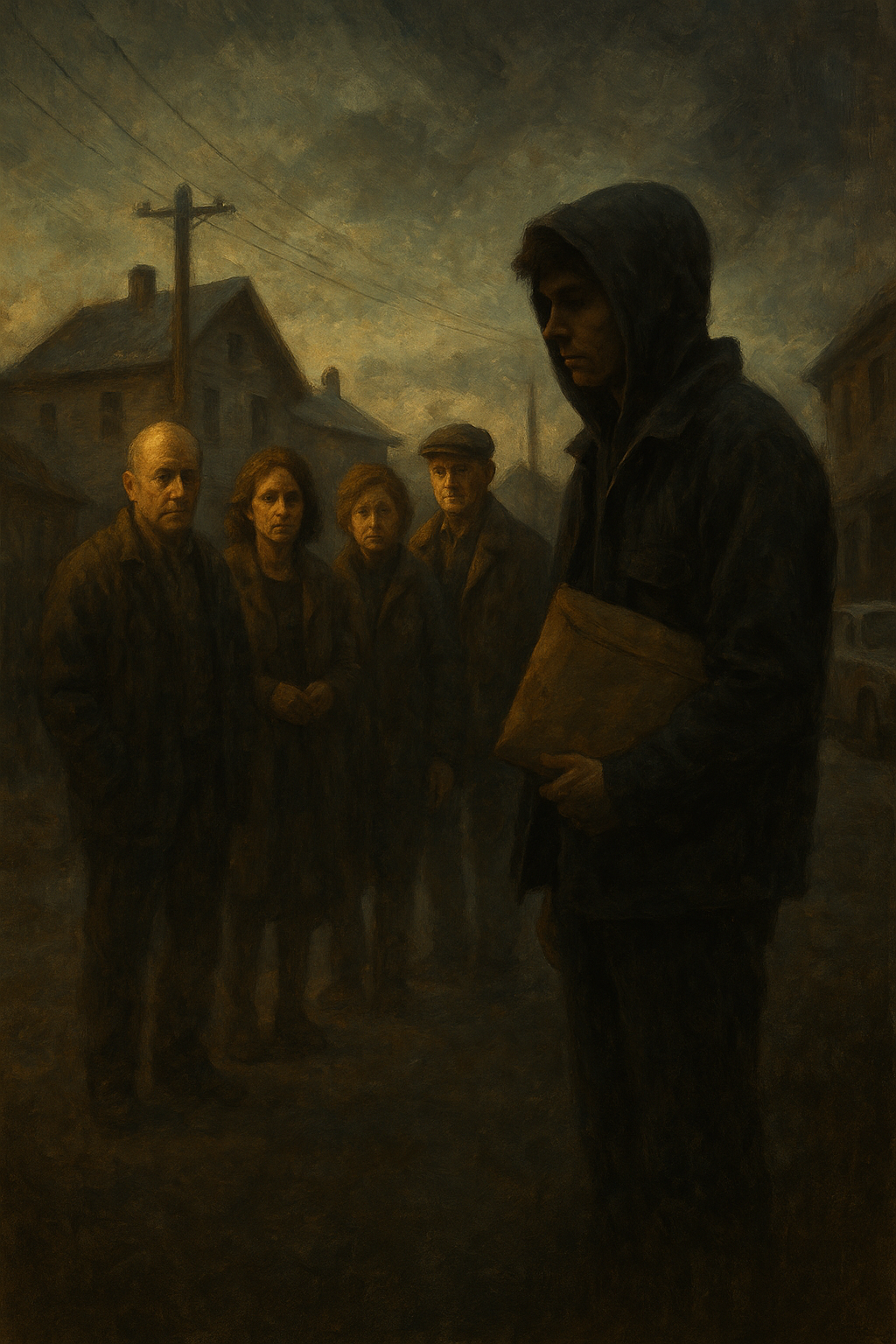
Poster for The Offset Arrives Thursday

The Offset Arrives Thursday

A recovered intake file and accompanying field notes document the brief operational life of a citizen-run print network distributing unsanctioned information through analog channels the CDA has not yet learned to intercept. The record is incomplete. Sections have been redacted under Cognitive Affairs Directive 7-F. What remains traces one courier — designated only by a case number — from first contact with the network to the moment a recommendation has been made.

Graphene
From The Turing Logs
Graphene
From The Turing Logs
← Back to overview

The Offset Arrives Thursday

6 chapters · ~23 min read

novella

A recovered intake file and accompanying field notes document the brief operational life of a citizen-run print network distributing unsanctioned information through analog channels the CDA has not yet learned to intercept. The record is incomplete. Sections have been redacted under Cognitive Affairs Directive 7-F. What remains traces one courier — designated only by a case number — from first contact with the network to the moment a recommendation has been made.

Chapter 1 · ~4 min read

First Impressions

5:50

The folder sits squared to the edge of a laminate desk the color of weak tea. Its tab label has been typed in courier, the letters bitten deep enough into the cardstock that you can read them by touch, and the case number that should sit beside the prefix has been inked over with a black bar so thick it has bled at the right edge into the manila itself. Whoever drew the bar pressed harder than they needed to. You can see, faintly, the ghost of the second pass. This is the front page of what we have. Not the front page of what existed. There is a distinction, and it will matter.

“

There is a distinction, and it will matter.

The document inside the folder identifies itself, on its cover sheet, as an intake file. The cover sheet is the only page of the file that does not appear to be a photocopy of something else. Beneath it, the pages shift weight. Some are typed on a machine with a sticking lowercase e. Some are handwritten in a small forward-leaning script with the loops half-closed, the kind of handwriting people develop when they expect to be read quickly and only once. Some are printouts from a system whose header has been clipped off above the staple line. The page numbers, where they exist, do not agree with one another. The file runs 1 through 14, then 1 through 9, then resumes at 22. It has been reassembled. Not by the person who wrote it.

What the cover sheet does say, in the section reserved for the originating authority, is this: Cognitive Affairs Directive 7-F, sub-clause governing retention of analog-channel field documentation, with the relevant subsection numbers struck through and rewritten in pen. The pen and the typewriter disagree about which subsection is operative. Neither has been corrected. The CDA. We will come back to the CDA. For now it is enough to say that the CDA is the body that drew the black bar, and the CDA is the body that decided which 1 through 14 came first, and the CDA is the body that did not include, anywhere in the assembled file, the key to the notation system the field notes use.

The field notes use a notation system. This is worth pausing on. On page four, in the small forward-leaning hand, the writer records a meeting with the subject and annotates it with a string of symbols in the margin. A circle. A circle with a slash. A circle with a slash and a number. On page seven the same sequence appears with the number changed. On page eleven the circle has become a square, which suggests a category shift, which suggests the writer was tracking something across encounters that they did not wish to name in plain language. The CDA, in preparing the file for review, has redacted the plain-language portions of several entries and retained the marginalia. Which means the part of the record that was already encoded has been preserved, and the part that was legible has been removed.

You could read this two ways. You could read it as oversight. You could read it as method. Somewhere in the middle of the file, on a page numbered 6 and also numbered 31, there is a transcript of what appears to be an intake interview. An officer asks the subject a question. The question has been redacted. The subject's answer has been preserved, and the answer is the word yes, and the word yes is followed by a parenthetical in the field writer's hand that reads after a pause of approximately four seconds. The officer asks a second question. The second question has been redacted. The subject does not answer. The field writer notes, in parenthesis, that the subject's hand moved toward the page on the desk and stopped, and did not complete the motion, and was withdrawn.

We do not know what was on the page. We do not know what was asked. We know the hand stopped one inch short, because the field writer measured it, or estimated it, or wanted us to picture it. The distinction between those three possibilities is the distinction this entire record will turn on, and the record has been designed, or has been damaged, in a way that does not let us settle it. The subject is referred to throughout by the case number. The case number has been redacted on every page it appears. There are forty-one pages. At the back of the folder, clipped to the inside cover, there is a single index card on which someone has written, in pencil, the word courier, and then crossed it out, and then written it again.

The folder closes. The black bar faces up. On the corner of the manila, just inside the edge, a ring of coffee has begun to soak into the cardstock in a perfect open circle, the residue of a cup that does not appear in any photograph of the session, that is not logged in the chain-of-custody sheet, that no one, by the official record, set down.

Next · Ch 2 →
Chapter 2: The Print Run, Unwitnessed
Chapter 2 · ~4 min read

Chapter 2: The Print Run, Unwitnessed

5:53

The smell is the first thing the file admits to. Not the press, not the room, not the hour. The smell. Linseed and solvent and something older underneath, the way a butcher shop smells of more than meat. It coats the soft palate. It outlasts the shift. The room has no windows. We know this because the field notes say so, and because the notes describe the ventilation in the way people describe ventilation only when there is nothing else to look at. A vent. A draft from the vent. The hum of a fan motor that cycles every ninety seconds and does not quite mask the press.

The press is hand-fed. You can hear it in the cadence the notes preserve, a clap and a pause and a clap, the pause being the human part. Sheet in. Pull. Sheet out. The operator is not named. The notes are scrupulous about this. Where a name would go, the notes give a measurement instead. Height of the operator, estimated. Reach of the operator, estimated. The distance, in centimeters, from the operator's left hand at rest to the lever. As if the body could be entered into the record without the person attached.

Case 14-Verdigris, the courier, is somewhere in this room or has been. The notes will not commit. There is a timestamp, 2:14, and the timestamp sits in a margin without an anchor. It could be the press starting. It could be the courier arriving. It could be a different night entirely. The CDA's redactors left the timestamp and removed the sentence that would have told us what it counted. This is the problem, in miniature. A timestamp without a verb.

The notes resume in the middle of the run. Forty-two sheets pulled. Ink coverage described as heavier than house standard, the operator compensating by hand. The paper stock is logged with the kind of care reserved for evidence, weight and grain and the small flaw at the deckle that the field-notes author seems to find reassuring, the way one finds a familiar face reassuring in a crowd. The author of the notes is, throughout, careful not to describe what is being printed. They describe the printing. This is worth pausing on. Most surveillance of a press concerns itself with content. What was said. What was claimed. The field notes here do the opposite. They behave the way a person behaves at the bedside of someone they are afraid of waking. They log the breathing. They do not lift the sheet.

When the notes do glance at the text, once, they call it the material, and they describe its effect on the operator's hands. The operator pauses longer than the cadence requires after certain sheets. The operator wipes their palms on their apron between specific pulls, not all of them. The notes record this and then record, in the clinical voice that has held the whole document together, that the pattern of pauses does not correspond to any structural feature of the layout the author can identify. The author writes, and this is verbatim, the operator is responding to something on the page that I cannot. Then the press jams.

“

This is the problem, in miniature.

The notes go quiet for half a line and resume with the half-sheet pulled free and held under the single work lamp clipped to a shelf above the bed of the press. The unfinished column on the right side of the sheet is what the notes describe. A list, partially set. Names. The notes give three of them, and then the redaction begins mid-sentence, a black bar that ends before the period, so that what survives reads, the fourth name in the column is, and then nothing, and then a period the redactors left in place like a door closed politely on an empty room. The period is the loudest thing in the chapter. You can hear the redactors deciding to leave it. You can hear them deciding the absence would do more work than the name.

Whoever read the field notes before us read that name. Whoever read it understood why it should not be on any list of this kind. The notes, in the lines that follow the redaction, describe the author's hands going still on the page. Describe the author setting the pen down. Describe a silence in which the fan cycles twice. Then the half-sheet, face-down on the concrete. The notes do not say who set it there. The notes say only that it was face-down, and that the corner nearest the vent lifted slightly, and lifted again, in the draft. The press is silent. The press is still warm. The operator, whoever the operator was, is not in the next sentence, because there is no next sentence. The entry ends.

What the file cannot tell us, and what the next pages will be asked to tell us, is whether Case 14-Verdigris was in the room when the sheet came off the press, or whether the timestamp in the margin belongs to a door opening somewhere else, at the same hour, on the same night, for an entirely different reason.

← Previous · Ch 1
First Impressions
Next · Ch 3 →
Resources Diverted
Chapter 3 · ~4 min read

Resources Diverted

6:14

The bicycle had been there since at least Tuesday. The narrator notes this not because anyone confirmed it, but because the back tire had gone soft in a way that takes about that long, and because the chain was beginning to wear the green off the fence post where it had been looped and re-looped by someone who didn't quite trust the lock. The building behind the fence had a directory under glass beside the front door. Three names had been removed from it, not unscrewed, not blacked out, but cut away with a razor blade at an angle that suggested someone working quickly while pretending not to. The adhesive squares were still there. You could see the faint outlines of where letters had been. If you stood close enough to fog the glass, you could almost read them.

The courier did not stand close enough to fog the glass. The courier, who we know preferred to arrive at drop points from the side rather than the front, who had once spent a paragraph of their intake interview describing the specific anxiety of approaching a building they had only seen on a hand-drawn map, walked past the directory without looking at it and went around to the service entrance.

The field notes for this period are out of order. This is worth pausing on. The pages are numbered, but the numbers don't run consecutively, and one page has had its bottom third torn off along a line that is almost, but not quite, straight. What remains on that page describes, in the passive voice, a quantity of paper stock that had been allocated for the week's run and was, by the time the courier arrived, no longer where it was supposed to be. Had been moved. Had been reassigned. Had been, the notes say, redirected toward priorities that the recorder does not name and may not have been told. In the margin of that page, in handwriting that does not match the rest, someone has written the courier's case number. Just the number. No annotation. No arrow. The pen is a different pen.

The drop-point locker was on the second floor at the end of a corridor that smelled, faintly and consistently, of toner. The courier had been to this locker eleven times. We know this because the courier kept count, in a notebook the field notes refer to but do not reproduce, and because on the twelfth visit, which is this one, the courier paused with their hand on the latch for what the recorder describes as longer than was usual. The locker was empty.

Not empty in the way a locker is empty when a pickup has gone correctly, which has its own quality, a kind of neutral vacancy. Empty in the way a room is empty when someone has just left it. The interior smelled of someone else's hands. There was a faint warmth along the back wall that the courier touched once with two fingers and then did not touch again. The courier stood there for a while. The field notes are specific about this. The recorder uses the word stood three times in two sentences, which is the kind of repetition that suggests the recorder was also standing somewhere, watching, and had nothing else to write down.

What the courier did next was check the ledger they carried in the inside pocket of their jacket, the small one with the cloth cover, and find that the week's allocation, which should have matched what was in the locker, did not match what was in the locker, because nothing was in the locker, and the allocation was for forty-two units of a thing the notes refer to only as material. Forty-two units that existed on paper and did not exist on the second floor. If the gap stayed a gap, the narrator will say only this: a gap in a ledger gets a name eventually. The name it gets is usually the name of whoever was standing closest to it.

The courier closed the ledger. Did not close the locker. Walked the length of the corridor once, slowly, and then a second time, looking, the recorder notes, for a second case number, though the recorder does not say how they knew that was what the courier was looking for. Elsewhere, and the narrator is going to be brief about this because brevity is what the moment can bear, the recorder of the field notes set down their pen and wrote a sentence at the top of a fresh page. The sentence began with the words resources have been and ended with a word that has been removed under Directive 7-F. What remains of the sentence is the verb, redirected, and the preposition, toward, and then nothing. The redaction is clean. The redaction is, if you look at it for long enough, almost careful.

“

Empty in the way a room is empty when someone has just left it.

The courier came back to the locker. The door was still open. On the inside of the door there was a small mirror, the kind installed for checking whether you've left anything behind, and in the mirror was the corridor the courier had just walked, except that in the mirror the corridor kept going. Past the stairwell. Past the end of the building. Into a length of hallway that the building, by any honest measurement, did not contain. The courier did not close the door. The courier walked away from it, and the field notes follow the courier, and the locker is left as it was left, which is open, with its small mirror angled to catch a corridor that goes on longer than it should. In the margin of the next page, the second case number does not appear again.

← Previous · Ch 2
Chapter 2: The Print Run, Unwitnessed
Next · Ch 4 →
An Elongated Greeting
Chapter 4 · ~4 min read

An Elongated Greeting

6:22

The hallway is twenty-two meters long. We know this because the field notes record it, and the field notes are, in the matter of distances, fastidious. At one end stands the courier, holding a paper bag folded twice at the top. The bag is described in the intake addendum as containing forty offset proofs, single-sided, uncut. Forty offset proofs weigh roughly two kilograms. The bag, by the recorder's own observation, hangs from the courier's hand at an angle that suggests considerably less.

At the other end stands a person the file does not name. The designation given is three characters long and appears nowhere else in the document. Not in the index. Not in the personnel appendix. Not in the cross-reference table that the recorder, elsewhere, treats as scripture. Either someone scrubbed the designation everywhere except here, or the recorder wrote a name they were not cleared to write and chose three characters at random to stand in for it. Both possibilities are bad. They are bad in different directions.

The courier, in this chapter, gets a physical description for the first time. The field notes give us: medium height, medium build, brown hair, brown eyes, no distinguishing marks. It is the description you would write if you were trying to describe someone and also trying not to. It is the description on a driver's license that has been issued to no one. The recorder, who elsewhere notices the brand of pen a subject uses and the way they hold a cigarette, here gives us a person who could be any person. This is, we think, on purpose. Whose purpose is the question. They walk toward each other. The notes record their pace as unhurried.

Now. We have to pause here and explain something about the network, because the moment that follows will not make sense otherwise. The network had a verification ritual for new couriers. It was called, in the internal shorthand, the handshake. It was a literal handshake, performed in a public-adjacent space, with a count. Three seconds. Release. The count was the verification. Anything longer was a coordination event. Anything shorter was a refusal. Three was the only correct number, and three was checked by both parties, independently, in their heads. The handshake in this hallway lasts longer than three seconds.

“

This is, we think, on purpose.

The field notes give the duration to one decimal place. We will not give you the number. The number is not the point. The point is that the recorder, whose prose elsewhere is clipped and procedural, devotes a full line to the duration and another full line to the observation that the grip tightened in the fourth second rather than loosening. Neither party spoke. Neither party looked away. The recorder, who was presumably watching from somewhere, records all of this in the tone of a person describing weather. It is the calmest paragraph in the file. It is the paragraph that, read in context, sounds like someone holding their breath.

What was exchanged during those seconds, the field notes do not say. There is no mention of an object passing. No mention of a word spoken. The recorder, who elsewhere transcribes overheard fragments verbatim, here records nothing. This is either because nothing was said, or because what was said could not be written down, or because the recorder was not close enough to hear and is too disciplined to invent. We are invited to choose. The file does not help us.

What the file does say, two pages later in a section that appears to belong to a different report entirely, is that the courier's intake was completed on a procedural anomaly. The handshake, the original handshake, the one that happens before a case number is assigned, the one that admits a person to the network in the first place, was never properly performed for this case number. Someone inside the network noticed. Someone inside the network let it stand. The field notes record this in a single sentence, in the middle of a paragraph about supply chain timing, as though hoping it might pass unnoticed. It does not pass unnoticed. It is the loudest sentence in the document. It is loud the way a held breath is loud.

The two figures in the hallway release each other. The grip, the notes say, loosened finger by finger rather than all at once. They step back. They turn. They walk in opposite directions, and the recorder, with the discipline of someone who has decided not to follow either of them, stays with the hallway. The paper bag is on the floor. Neither of them is carrying it now. The notes do not say which one set it down, or when, or whether the other one saw. The bag sits in the approximate center of the hallway, folded twice at the top, exactly as it arrived. It does not tip. It does not settle. It is too light to settle.

The footsteps retreat in both directions and grow faint at different rates, which suggests the two figures are walking at different speeds, which suggests one of them is in a hurry and the other is not, and the field notes, for once, do not tell us which is which. The bag stays where it is. The hallway holds it. The fluorescent lights, the recorder notes, hum at a frequency slightly above the usual.

← Previous · Ch 3
Resources Diverted
Next · Ch 5 →
Signatures of Dissent
Chapter 5 · ~4 min read

Signatures of Dissent

5:51

The document lies flat under the clip lamp, and the clip lamp throws a circle of light the size of a dinner plate onto the paper, and inside that circle the paper is very white and very still. It is a single sheet. Letterhead blacked out. Body text intact. At the bottom, a row of fields the form calls AUTHORIZING PARTY, RECEIVING PARTY, DATE OF EFFECT. The first field is empty. The second field is empty. The third field has been crossed through with a single horizontal line and a second date written above it in the same hand that crossed the first one out. At the bottom right, two pencil marks.

They are so faint you would not see them if you were not looking. They could be pressure. They could be the ghost of writing that happened on the page above this one and traveled down. They could be initials. The courier is looking at them and trying to decide which of those three things they are, and the field-notes author, whose handwriting we have learned to recognize by now, has written in the margin a single word and then crossed it out, and the crossing out is heavier than the word itself, so what remains is a black bar with the shape of letters fossilized underneath. Under the black bar, in fresh pencil, the word reads: confirm.

The courier has been in the room for forty minutes. The room is the back of a copy shop that closed at six. The courier was told the file would be here and the file is here, which is the first thing that has gone according to expectation in eleven days. They have not eaten since the bus. There is a thermos on the table that someone else filled and left, and they have not touched it.

“

They are so faint you would not see them if you were not looking.

The form is an internal authorization. The courier knows this because the form numbers itself in the top left, and the number matches a number they have seen once before, on a clipboard, on a loading dock, in the hand of a woman who did not look at them when she passed it over. Authorization forms exist to record that something has been permitted. Someone has to permit them. That someone signs at the bottom right. The courier reaches out and touches the two pencil marks with the pad of one finger. The pencil does not smear.

This is the moment to sit with. The graphite has set into the grain of the paper. Whoever wrote those initials wrote them long enough ago that the oils of a fingertip will not move them. Days, at least. Possibly longer. The form was authorized before the courier ever saw the loading dock, before the bus, before the handshake the field notes recorded with such careful neutrality in the second week. The form was authorized, and then it traveled, and then it arrived here, and the courier has been moving through a sequence whose first signature was already dry.

The initials are H and something. The second letter could be an A. It could be a K. It could be the back half of a letter whose front the pencil never finished. There is no Harper in the file's character index. The courier checked the index twice on the bus and once in the alley behind the shop, and the index runs from a name beginning with B to a name beginning with W and contains no H at all. The field notes, elsewhere in the file, refer to a recommendation that has not yet been made. The recommendation will be made by someone with the authority to make it. Authority, in this kind of record, is a thing you can locate by following ink.

The ink of the form's body text is black. The pencil of the initials is pencil. The crossing-out of the date is a third instrument, ballpoint, blue. Three hands have touched this page. The courier has touched it with a finger that left no mark, which means, for the moment, four. Above the crossed-out date, in the corner where forms like this carry their case reference, a number has been written and then struck through. It is the number from the loading dock. It is the number the field notes opened with in the chapter we are not in. A line has been drawn through it cleanly, left to right, the way you cross out something that is finished, or something that is no longer the question. The courier looks at the crossed-out number for a long time.

They do not write anything on the form. They do not sign. They sit with their hand flat on the table beside the paper and they breathe through their nose, and somewhere in the front of the shop a refrigerator cycles on and then off, and the clip lamp hums the way clip lamps do. Then they reach up and switch the lamp off. The room goes black all at once, the way small rooms do when their only light leaves them. The document is still on the table. The initials are no longer visible. But the paper, where the pencil pressed, is pressed still, and will be pressed in the morning, and will be pressed when someone else comes to collect the form and carry it to whoever signs next.

← Previous · Ch 4
An Elongated Greeting
Next · Ch 6 →
Final Leaf Turned
Chapter 6 · ~3 min read

Final Leaf Turned

5:22

The folder is on the desk again. Thicker now, by a dozen pages or so, the kind of thickness that gives a folder its first hint of architecture, the spine beginning to assert itself. The label has been re-inked. Whatever case number sat beneath that black bar in the first chapter has been worked over so many times the cardboard has begun to pill. You could scrape at it with a fingernail for an hour and find nothing. Someone has made sure of that. The coffee ring is still on the corner. The same coffee ring. Concentric, brown, slightly oblong where the cup was set down at an angle by someone who wasn't paying attention, or who was paying attention to something else.

Inside, the field notes have resumed, briefly. The author's handwriting in these last pages is smaller than it was at the beginning. People's handwriting does that when they are trying to fit more onto less paper, or when they have started to suspect that paper itself is finite. The entries are dated, then undated, then dated again with a different pen. They describe the courier in the third person, as they have throughout, and they describe the courier's movements through the network with the patience of someone who has watched something carefully for a long time and is no longer surprised by any of it. The last legible entry is a short one. It notes that the recommendation has been forwarded. It notes that Harper's initials are on the cover sheet. It notes that the courier, as of this writing, does not know.

And then it ends mid-sentence. Not at a dramatic word. At a preposition. The kind of break that suggests the writer was interrupted, or chose to appear to have been interrupted, which in a document like this amounts to the same thing. After that, six pages. All redacted. Not partially. Fully. The black bars have been laid down in overlapping passes until the pages are nearly stiff with ink, the way a wall gets stiff under too many coats of paint. You can hold one up to a lamp and see nothing. Someone tried. The lamp is still on.

“

The author's handwriting in these last pages is smaller than it was at the beginning.

The recommendation itself is on the last page. A form. Standard issue, the kind the Directive prints in batches of ten thousand and stores in a warehouse no one has ever taken a picture of. Three checkboxes. The first two are labeled in the clear. Continuation. Termination. The third is blacked out. The third is checked. A hand turns the page. It is not the courier's hand. It is not the intake officer's hand. It belongs to no one named anywhere in what remains of the file. The hand turns the last leaf and does not turn it back. It rests there for a moment, fingertips against the underside of the page, the way a person rests a hand on a door they have decided not to open again.

What the third box means is not written down. But the Directive has a vocabulary for what it does to people, and the vocabulary has gaps in it, and the gaps are where the third box lives. A courier who is no longer a courier. A carrier reclassified as something the network carries. Not removed. Repositioned. Folded inward. The mail route becomes the mail.

The field-notes author understood this. The field-notes author had reason to understand this. Somewhere in a different drawer, in a different building, there is or was a case number with a line through it, and the line was drawn by someone who knew exactly what they were drawing it through. That author wrote these notes. That author also assembled this file, page by page, from the inside of the thing the file describes, which is the only place from which a file like this could be assembled at all. The courier has been reading about the courier. This has been true for longer than the courier knew. The hand withdraws. The folder closes. The cardboard makes the small sound cardboard makes, a sound like a held breath being let out into an empty room.

The coffee ring is still on the corner. It has not faded. It has not spread. It is the same ring, in the same place, as though no time has passed at all, or as though the time that passed has been removed along with everything else, lifted out cleanly, the way a surgeon lifts something out and sets it on a tray and does not look at it again. The folder sits on the desk. Closed. Thicker than it was. Labeled in a number no one can read. Someone will come for it Thursday.

← Previous · Ch 5
Signatures of Dissent
Back to show →
The Offset Arrives Thursday