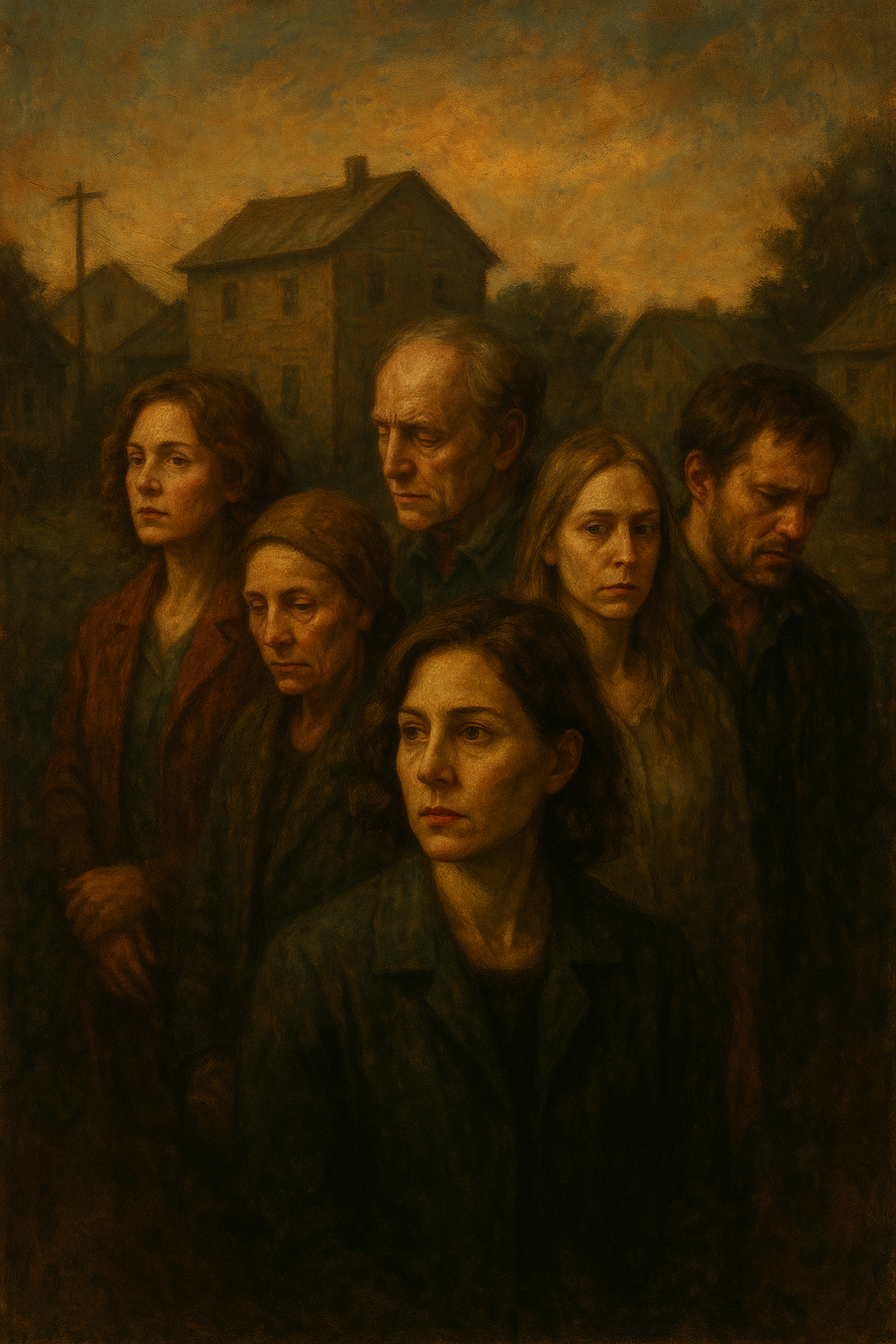
Poster for Longer Than an Hour

Longer Than an Hour

A portrait photographer renowned for capturing beauty begins to notice that her most celebrated subjects—faces she once considered timeless—are quietly unraveling their own lives through small, corrosive choices. As she revisits them years later for a retrospective exhibition, she must decide whether to show the world what her lens now sees or protect the myth she helped create.

Graphene
Graphene
← Back to overview

Longer Than an Hour

6 chapters · ~26 min read

novella

A portrait photographer renowned for capturing beauty begins to notice that her most celebrated subjects—faces she once considered timeless—are quietly unraveling their own lives through small, corrosive choices. As she revisits them years later for a retrospective exhibition, she must decide whether to show the world what her lens now sees or protect the myth she helped create.

Chapter 1 · ~4 min read

Through the Lens

5:55

A face fills the viewfinder. Pores along the cheek catch the lamp like fine grain in paper. A faint scar runs along the jaw, the kind a person stops noticing in mirrors but a camera never forgets. One eye sits a hair lower than the other, which is the thing that makes the face interesting, and which the face itself has spent twenty years arranging itself to hide.

•••

The photographer waits. Her name is Hela Voss, and the trade press has, for most of a career, called her work timeless, which is a word she has come to distrust the way a doctor distrusts the word fine. She is fifty-three. Her studio occupies the second floor of a converted print shop, and she shoots with available light when she can get away with it, and a single soft box when she can't. What she is known for, more than the prints themselves, is the pause. The wait. The way she will stand at the camera for thirty, forty, sometimes ninety seconds while her subject performs and then forgets to perform, and only then does she let the shutter fall.

•••
“

What she is known for, more than the prints themselves, is the pause.

The subject in the chair right now is Mara Linde. The face. The one Hela photographed twenty years ago in a borrowed kitchen and made, in the course of an afternoon, into something the culture decided it needed. Mara is laughing at something Hela hasn't said. Her hands are folded in her lap, which is unusual. Mara is a person who talks with her hands. Today the hands are folded because folded hands do not shake. Hela has noticed. She noticed in the first three minutes. She is trying, now, not to have noticed. "Tell me about the house in Lisbon," Hela says, because Mara loves the house in Lisbon, and a person talking about something they love will eventually stop guarding their mouth.

•••

Mara talks. The light is good. The composition is good. Hela's finger rests on the shutter release the way a pianist's finger rests above a key, and twice in the first ten minutes it wants to fall, and twice Hela does not let it. Because what the finger wants is the shot where Mara's mouth is still smiling and her eyes have gone somewhere the smile cannot follow. That shot exists. Hela can see it gathering at the edges of the face like weather. It would be, she knows without arrogance, one of the better photographs she has ever taken. It is also not the photograph anyone has agreed to.

•••

So she waits for the easier one. The composed one. The Mara that the gallery wants and that Mara, sitting very straight in the chair with her hands folded, has come here to deliver. When it arrives, Hela takes it. She takes it three times, four. The shutter is quiet. Mara does not flinch. Good, Hela thinks. Good girl. Which is a thought she will be ashamed of later and is already a little ashamed of now. They break at the hour. Mara goes to find water. Hela stands at the camera with her hand on the back of her own neck and looks, for the first time since Mara arrived, at the wall behind the lights.

•••

There is one framed print on that wall. Only one. It is not Mara. It is a face Hela has never publicly named, and which she has hung and rehung in four different studios across three cities, always in a sightline she cannot avoid. The print is the one she keeps returning to. She does not look at it long. She never does. When Mara is gone for the afternoon, Hela goes to the archive drawer at the back of the studio and pulls a contact sheet from 2004. She lays it on the lightbox and clicks the bulb on, and the small grid of frames comes up cold and white and exact. Mara at twenty-nine, in the borrowed kitchen, laughing at the photographer she had not yet learned to manage. Thirty-six frames of a person who did not yet know she was about to become a face.

•••

Hela bends close. She has not looked at this sheet in a long time. She expects to feel the old proprietary warmth, the small private pride of having seen first. What she feels instead is harder to name. The woman in frame eleven is looking directly into the lens with an openness that the woman who left this studio an hour ago could no longer produce if you paid her. And Hela understands, with the quiet of a thing understood too late to act on, that some of what closed that openness was the picture she is presently holding. That she helped build the room the woman is now trapped inside. That she has, for two decades, been called a witness to a face, when in fact she was one of the architects. She stands at the lightbox a long time.

•••

Then she turns the contact sheet over, careful, the way you'd turn a letter you weren't ready to answer. She leaves it face down on the glass. She does not switch off the bulb. She walks out of the room, and behind her the lightbox goes on humming, lit, holding what it holds.

•••
Next · Ch 2 →
Chapter 2: What the Years Left Behind
Chapter 2 · ~4 min read

Chapter 2: What the Years Left Behind

6:20

The Post-it was already curling at the corners, the address written in the photographer's own hand two days ago and ignored since. She had idled in the strip mall lot for eleven minutes, engine running, the air conditioner pushing back against the flat white sun on the asphalt. A nail salon. A tax preparer with a hand-drawn sign. A vacancy. And, at the end of the row, the apartments above, accessed by a set of outdoor stairs the color of dead grass. She had built her career on patience. The trick, she told a magazine once, was to wait until the face forgot you were there. She was waiting now, but for something different. She was waiting to want to go up the stairs.

•••

The curator had called on Tuesday. A retrospective, the curator said, like the word was a gift. Twenty years, the celebrated ones, the portraits people had clipped and pinned and tattooed. Revisited, the curator said, and the photographer had heard the second syllable land harder than the first. The curator wanted new work alongside the old. The same faces, now. She had said yes before she understood what she was agreeing to look at. That had been Tuesday. Then there had been the visit to Mara, which she was not yet ready to think about as a visit to Mara, and which had rearranged the furniture in her chest. She had drawn up a list on the back of a receipt. Three names for one afternoon. A small clinical study disguised as a social call.

•••
“

She had built her career on patience.

She killed the engine. The heat met her at the door of the car like a person she owed money to. Maren lived on the second floor. The magazine, in 2009, had called her luminous. The magazine had used that word about a lot of women that year, but with Maren they had meant it, and the photographer, who had taken the picture, had meant it too. Maren at twenty-six, in a white slip, her hair wet, looking at the camera as if she had just remembered something private and decided not to share it. That photograph had paid for the photographer's first real studio. She climbed the stairs. She knocked.

•••

The door opened, and the photographer's hands moved before her thinking did. She felt them lift, slightly, at her sides. She felt her eye go to the window behind Maren's shoulder, the one that would put the light across the left side of her face, and she felt the small involuntary calculation of where she would place her, what she would ask her to do with her chin. She had composed the shot before she had said hello. She made her hands stop. "You came," Maren said. "I said I would." "People say." Maren was forty-one. She was still, by any honest measure, beautiful. The bones the camera had loved were still where the camera had left them. But something in the assembly had shifted, the way a house shifts. Not ruin. Settlement.

•••

They sat in a small living room that smelled faintly of cigarettes and a candle trying to cover them. Maren made coffee in a French press with a chipped plunger. She talked quickly about nothing, about the neighbor's dog, about a show she was watching, about how she had been meaning to call. The photographer asked the easy questions, the ones a friend would ask, and watched Maren's mouth, and her hands, and the way her eyes moved to the door whenever a car passed in the lot below. The photographer mentioned, almost in passing, that there was going to be a show. Some of the old work. Maybe some new. "Oh," Maren said. "God. Am I in it." "You're in it if you want to be."

•••

Maren laughed. The laugh came too fast, before the sentence had fully closed, and it came at a volume that did not match the room. It went on a beat longer than the joke could carry. Then it stopped, clean, like a tap. The photographer did not look up from her coffee. She had spent her life training herself not to react to faces, so that the faces would keep doing what they were doing. She kept her face the way she kept her hands at a shoot. Available. Empty. Receiving. "I'd have to think about it," Maren said. "Of course." "I don't look like that anymore." "None of us do."

•••

Maren smiled at this, gratefully, as if a debt had been quietly forgiven, and the photographer felt the small private cost of having let her think so. She had not come here to forgive anything. She had come to see. She stayed forty minutes. She asked nothing she had driven there to ask. When she stood to leave, Maren hugged her at the door, and the hug was a beat too long, and the photographer let it be.

•••

In the hallway, on her way out, she passed the photograph. Her own photograph. The white slip, the wet hair, the private thing not shared. It hung in a black frame at eye level, and the frame was crooked, tilted maybe two degrees off true, the kind of crooked a person walks past every day and means to fix. The glass was filmed with a soft, even dust, the kind that takes months to settle and longer to notice. The photographer stood in front of it for what she would later decide was too long. She did not straighten it. She went down the stairs into the white afternoon, and she got into the car, and she sat with her hands on the wheel, and she looked at the next name on the receipt.

•••
← Previous · Ch 1
Through the Lens
Next · Ch 3 →
Chapter 3: Small Choices, Long Shadows
Chapter 3 · ~4 min read

Chapter 3: Small Choices, Long Shadows

6:20

The hose was the first thing she saw. Coiled on the brown lawn like something asleep, the nozzle still leaking onto a patch of clay split open in three directions, the way old plaster splits. Water beaded, paused, fell. Beaded, paused, fell. A small sound in a yard that had clearly been promised better. Dov's house in the photograph she took of him in 2003 had a lemon tree by the front step. The lemon tree was still there. It was not, strictly speaking, alive. She stood on the walk a moment longer than she needed to, camera bag on her shoulder, and counted the lemons on the ground. Six. She didn't know why she counted them. She had been counting things all week. He opened the door before she knocked.

•••

Dov at sixty-one was thinner than Dov at forty-five, and in a way that suggested subtraction rather than discipline. He'd been a cellist when she photographed him. He was, technically, still a cellist, though the orchestra had let him go in 2019 for reasons that had been written about in a small, careful paragraph in a regional paper, and she had read that paragraph twice and then closed the tab. He hugged her. He smelled like coffee and something underneath the coffee.

•••

She set her camera bag on the kitchen table, and that was when he did it. She would replay this later, on the drive, and she would be certain she had seen it and certain she had pretended not to. He slid a folded document, legal-sized, cream-colored, halfway under his coffee mug. Not hidden. Staged. The corner of it still showed, the way a magician shows you the card he wants you to forget he showed you. She lifted her eyes to the window above the sink and said something about the lemon tree. "It died last spring," he said. "I keep meaning to." He didn't finish the sentence. He didn't need to.

•••

They talked about the retrospective. He asked who else. She gave him three names, withholding the fourth, the one she always withheld now, and he nodded at each like he was checking them off a list he'd already made. He poured her coffee. He poured his own and then, after a pause that was not quite long enough to be a pause, poured something into his from a bottle on the counter that was not labeled like a thing you put in coffee at ten in the morning. He did it without ceremony. He did it the way a person ties their shoe. She watched him do it. He watched her watch him. Neither of them adjusted their face.

•••
“

She lifted her eyes to the window above the sink and said something about the lemon tree.

This is the thing about small choices. They are small. That is the whole problem. A person can make one and a person watching can decide they didn't see it, and both people can go on with the morning, and the morning will close over the choice like water over a stone, and only later, much later, when you are counting lemons in a dead yard, will you understand that the stone is still down there, and there are others, and the bottom of the pond is paved with them. She asked if she could photograph him in the front room, by the window. He said of course. He brought his coffee with him.

•••

She had not planned to shoot today. Today was supposed to be the conversation, the reacquaintance, the reading of the room before the session next week. The camera was in the bag for insurance, the way some people carry an umbrella. But when he sat down in the chair by the window, and the light came across his face the way light had always come across his face, generous, forgiving, a light that had once made her career, she found her hand was already inside the bag.

•••

She lifted the camera almost without deciding to. He didn't pose. He was looking at the mug in his hand, and the mug was sitting on the folded document on the side table now, he had brought it with him, he had brought the document into the room with the light, and his mouth was doing something his mouth had not done in 2003. A small downward thing. Not grief. Smaller than grief. The face of a man calculating how much was left of something. She took the picture. The shutter was quiet but not silent. He looked up. He smiled, the old smile, the one she'd put on a magazine cover, and said, "Was that one for the wall, or for you." "For me," she said. He nodded. He believed her. He had always believed her. That had been, from the beginning, the arrangement.

•••

She checked the back of the camera. The image was there. Him, the mug, the document, the mouth. She looked at it for longer than she should have with him in the room and then she lowered the camera and they talked about his daughter for twenty minutes and she did not delete it. At the door, he hugged her again. He said, "It's good. To be seen by you. Still." She got into her car. She set the camera on the passenger seat. She put her hands on the wheel and didn't start the engine for a moment, and then she picked the camera back up and checked the back of it a second time, just to be sure the picture was still there, as if pictures could leave on their own, as if she'd half-hoped one had. It was still there.

•••

She put the lens cap on. She set the camera back on the seat. She drove home with it riding shotgun, cap on, screen dark, the whole forty minutes, and she did not turn on the radio, and she did not look at it again, and she did not, at any point, decide what she was going to do with what she had just done.

•••
← Previous · Ch 2
Chapter 2: What the Years Left Behind
Next · Ch 4 →
Debating the Retrospective
Chapter 4 · ~5 min read

Debating the Retrospective

7:35

The corkboard ran the length of the south wall, two rows of eleven by fourteens pinned in a grid that the heat from the overhead vent had begun to bow. The top row curled toward the ceiling. The bottom row curled toward the floor. From across the room they looked like a mouth starting to open.

•••

Elin Vasser had arrived early, which was unusual. The director, Petra, had arrived earlier, which was not. Petra kept a kettle in her office and a second kettle in her car for reasons she had once explained at length and which Elin had stopped trying to remember. There was tea now, and the smell of paper warming, and the small clean sound of Joseph Aldred unpinning and repinning a print to make it lie flatter against the board. Joseph had been Elin's printer for nineteen years. He had also, in 2008, talked her out of burning a contact sheet she now considered the best work of her thirties. He was allowed to be in this room. He was, arguably, the reason this room existed.

•••

Petra had laid out the show in sequence. Elin walked the length of it once without speaking. The early portraits first, the ones the press kit leaned on, the faces that had built the catalog: a violinist at twenty-three with her chin lifted into a slab of north light. A boy on a fire escape in a borrowed coat. And, fourth from the left, larger than the others by a deliberate inch, Maren. Maren at thirty-one. The portrait that had been on three magazine covers and one postage stamp in a country Elin had never visited. The portrait that the National Portrait Gallery had asked, twice, to borrow. Maren looking just past the lens with the particular composure of a person who has decided, in that exact second, to be photographed. It was a very good picture. Elin had taken it in under four minutes.

•••

"We open with the violinist," Petra said, "and we anchor the first room with Maren. The sponsors have already seen the layout. The Times has already seen the layout. I'm telling you this so you understand the layout has been seen." "I heard you," Elin said. "I want to make sure." Joseph had stopped repinning. He was watching Elin's bag, which she had set on the chair by the door and not opened. Inside the bag were six prints he had made for her the previous Thursday on his own time, off the books, because she had asked him to and because he had not yet decided what he thought about being asked. "There are some newer images," Elin said. "From the revisits. I'd like to talk about swapping two." Petra did not move. "Which two." "The violinist. And Maren."

•••
“

There was a small sound from Joseph that was not a word.

There was a small sound from Joseph that was not a word. Petra crossed to her desk and sat down in the way a person sits down when they intend the conversation to last. "Show me." Elin took the prints out of the bag one at a time and laid them on the desk in the order she had rehearsed in the car. She did not rehearse what she would say about them. She had decided, somewhere on the drive in, that she would let them speak and see what they said in a room that wasn't hers. Petra looked at them for a long time. She looked the way she looked at insurance paperwork. "These are extraordinary," she said finally, and Elin felt the first thin hope of the morning, and then Petra said, "and we are not showing them." "Petra."

•••

"We are not showing them in this exhibition. We can talk, in a year, about a different exhibition. We can talk about a book. We are not unspooling the retrospective six weeks out because you've had a feeling." "It isn't a feeling." "It is the most expensive feeling I have ever been asked to underwrite." Joseph had come closer. He was standing at Elin's shoulder, looking down at the prints he himself had pulled, and his face had gone into the careful neutral he wore when he was about to say something he had been preparing for days. "Did they sit for these," he said. Elin didn't answer immediately. "Elin. Did they sit for these." "They knew I was there." "That isn't the same question."

•••

Petra had stood up again. She walked to the corkboard. She tapped the Maren print with one knuckle, a soft sound, like testing fruit. "This," she said, "is timeless. This is what people are coming to see. This is what they bought tickets to see. You took this picture. You don't get to be embarrassed by it now because you've learned something about her you wish you hadn't." Elin's hand was around her coffee cup. The cardboard gave a small dry crackle and then a longer one, and a seam at the lip split, and a thread of coffee ran down over her thumb and onto the cuff of her sleeve, and she did not put the cup down. She watched it bleed into the cotton. "Timeless," she said. "Yes." "That's the word." "That is the word, Elin, yes." Joseph said, quietly, "You're not documenting beauty anymore. You're documenting consequence."

•••

The vent clicked off. The room got very quiet in the particular way a room gets quiet when the white noise it had been hiding under stops. Elin looked at Joseph. Joseph looked back. He was not unkind about it. He was not even angry. He had simply named the thing and was waiting to see if she would deny it. She didn't. She didn't agree either. She just stood there with coffee on her cuff and the cup buckling in her hand and let the sentence sit in the air between the three of them, and Petra, who had spent thirty years watching people make and unmake their careers in her office, registered the silence and went still, because she knew what a silence like that meant in a room with prints on the desk.

•••

After a long moment Elin set the cup down. She reached across and slid one of the prints out from the stack, the one of Maren at forty-three taken through the kitchen window in November, and she laid it flat on the table between them, face up, in the empty space beside the layout. None of them touched it. Petra did not move it back toward Elin. Elin did not move it back toward herself. Joseph put his hands in his pockets, which was the thing he did when he wanted to make sure they stayed there. Outside the office, in the gallery proper, someone was running a vacuum, and the sound came through the wall in long even passes, like weather.

•••
← Previous · Ch 3
Chapter 3: Small Choices, Long Shadows
Next · Ch 5 →
Decisions of Display
Chapter 5 · ~4 min read

Decisions of Display

6:19

At two in the morning the studio is a darkroom in the literal sense, red bulb humming over the worktable, the rest of the building gone quiet in that way old industrial buildings go quiet, like a held breath. Helene has spread them out the way a card dealer spreads a hand. The originals on the left. The new prints on the right. Twelve faces, twice. Twenty-four reasons to be awake. The originals don't need her anymore. They've been published, framed in other people's hallways, set as the lock screens of people she's never met. They sit on the table like postage stamps. Pristine. Closed.

•••
“

The originals don't need her anymore.

The new ones are wetter, somehow, even dry. She printed them herself this week, by hand, the way she used to before she could afford not to. There is Daniel at the kitchen window with the light catching the slack under his jaw. There is Inez in the doorway of the house she will lose by spring. There is the dancer whose name she will not say aloud anymore, even to herself, sitting on a folding chair with both feet flat on the floor. And there is Maren.

•••

The phone had rung at eleven forty. Helene let it. The voicemail came in under a minute, and she played it once, standing, the way you stand for bad news from a doctor. Mara, who eighteen years ago had been the cover of the book that made Helene's name, said the word lawyer twice and the word consent once and the word please not at all. The proof had reached her through someone at the gallery. Helene could guess who. It didn't matter. The threat was simple and Mara was within her rights and the deadline at the gallery closed at midnight tomorrow and there were, Helene counted again, twelve faces on each side of the table.

•••

She pours coffee she will not drink. She moves the prints around. She tries one arrangement where the originals hang first and the new ones hang second, a then and now, the cheapest possible grammar. She tries another where they alternate, and that's worse, a card trick. She tries a third where only the new ones hang, and the room in her head goes very still, and she knows that is the show, and she knows she cannot have it.

•••

She does the cowardly math first because the cowardly math is also the practical math. Pull Mara, keep the gallery. Pull Mara, keep eleven of the new portraits, which is still more truth than anyone in her field has put on a wall this decade. Pull Mara, and the show opens, and people walk through it, and something gets seen, even if the one face that started all of this stays in a drawer. She picks up the new photograph of Maren.

•••

It is not the same person as the voicemail. Mara is the name on the release form. Maren is the name only Helene uses, the name from the first sittings, before the book, before the cover, when the girl in front of her camera was twenty-two and had a habit of tilting her chin a quarter inch to the left when she lied. In the new print she is forty, and she is not tilting anything. She is looking straight into the lens with the particular flatness of a person who has been spending money she does not have on a man she does not love, and the camera has caught it the way cameras catch weather.

•••

Helene carries the print across the room toward the submission envelope. Eight steps. She has counted them before, on other nights, with other prints. At the envelope she stops. She holds the photograph above the open mouth of it. She lowers it. She does not put it in. She sets it down on the table beside the envelope instead. Face up. Not hidden. Not submitted. Then she gathers the other eleven new prints, and four of the originals, the four she can still stand, and she slides them into the envelope in the order she wants them hung. She licks the seal. She presses it down with the flat of her hand and holds it there longer than she needs to.

•••

She takes a marker from the cup by the enlarger. On the front of the envelope, in the blank space where the gallery expects a word, she writes draft. Not final. Draft. Four letters, lowercase, and she caps the marker and sets it down and looks at what she has written for a long time. On the wall above the worktable, pinned there for as long as anyone who has visited this studio can remember, is a print Helene has never explained to a single interviewer. A woman, three-quarter profile, twenty-two years old, chin tilted a quarter inch to the left. It is the same face as the photograph she has just set aside.

•••

She lifts the new print from the table and props it against the wall directly beneath the old one, leaning, not pinned, the bottom edge resting on the baseboard and the top edge tipped out toward the room. Two versions of one person, stacked, the younger above and the older below, and a narrow dark gap of wall between them where the red light doesn't quite reach. The envelope sits sealed on the table. The print leans against the wall like a door someone has left open on their way out, or on their way in. Helene turns off the safelight. In the dark the two faces are still there, she knows exactly where, and she stands in the doorway of her own studio for a while before she goes.

•••
← Previous · Ch 4
Debating the Retrospective
Next · Ch 6 →
Tracing the Extended Path
Chapter 6 · ~5 min read

Tracing the Extended Path

7:39

The gallery on opening night looked the way she had wanted it to look only once, in a sketch she'd made on the back of a contact sheet two years ago, and that almost never happens. The portraits were lit from a single bank above, no spots, no theater. Each face was nearly six feet tall. People moved through the room with their chins slightly lifted, the way people stand under a sky that might do something. A waiter passed with thin glasses. Somewhere near the door, a child asked her mother if the lady in the big picture was sleeping, and the mother said no, just thinking, which was wrong but kind. She had hung sixteen portraits. She had decided, at four in the morning, on fourteen.

•••

The two she added back were the ones she'd been arguing with herself about since spring. Not the withheld image. That one was still upstairs in the flat file, in its sleeve, where it had lived for eleven years. The two she'd added were Joel at thirty-one, before the second marriage, and Anneke in the green coat, the week before her diagnosis she didn't yet have a word for. Beauty, in both cases. Beauty that the intervening decade had since revised. She had decided to let the revisions stay where they lived, which was in the people, not on the walls.

•••

What she had done instead, the thing she would not be able to undo after tonight, was hang the contact sheets beside three of the portraits. Small, in narrow frames, at hip height. You had to want to look. On the sheets you could see the frames she hadn't chosen. The blink. The laugh that went wrong. The moment just after, when the face came back to itself and was a little less. She had not labeled them. She had not explained. It was, she understood, the smallest possible honesty. It was also the largest one she could survive.

•••

Maren came in at nine fifteen. She was wearing black, which she never wore, and her hair was shorter than the last time, and she walked through the room the way she had always walked through rooms, which is to say as if the room had been waiting. People turned. People always turned. The portrait of her at twenty-six was on the long wall, eight feet of her looking just past the camera at something the photographer had said to make her stop performing. It had been on a postcard, once. It had been on the side of a bus.

•••
“

It was, she understood, the smallest possible honesty.

Maren stopped in front of it. She did not look for the photographer first, which was a kindness, or a strategy, or both. She stood close enough that a guard, if there had been a guard, would have said something. She lifted two fingers and touched the frame. Just the frame. The wood, not the glass, not the face. She held them there for maybe three seconds. Then she let her hand drop and turned and found the photographer across the room with the ease of someone who had known exactly where she was the whole time. She crossed. The photographer did not move. She had decided, at four in the morning, that she would not move. The sixty seconds that the rest of her life would be measured against began somewhere around Maren's third step.

•••

Maren stopped in front of her. Up close her face was the face on the wall and also not. The difference was not age. The difference was that the woman on the wall did not yet know what the woman in front of her had since learned about being looked at for a living. "You kept it down," Maren said. "I kept it down." "The other one." "Yes." Maren nodded once, slowly, as if confirming something to a third party who wasn't there. Her eyes went, briefly, to the contact sheet beside the portrait of Joel, then back. "You could have shown it," she said. "I would have understood why." "I know." "That isn't the same as forgiving you." "I know that too."

•••

There was a pause then in which a great deal happened on Maren's face and none of it on her mouth. The photographer had spent twenty years learning to read exactly this kind of pause and she made herself, now, not read it. It was not hers to take. "It was mine," Maren said finally. "Whatever it was. It was mine." "Yes." "And you knew that." "I knew that tonight." Maren almost smiled. It was the smile of someone deciding not to spend the rest of an evening on a thing. She lifted her glass in a gesture that was not quite a toast and not quite a goodbye and walked away through the crowd, and the crowd, which had been pretending not to watch, resumed pretending not to watch.

•••

The photographer stood where she was for a long time. People came up. People said the kind of things people say. She answered them. At some point she realized she had not been holding a drink, and then she was, and then she wasn't again. By eleven thirty the room had thinned. By midnight the caterers were stacking glasses into gray plastic tubs and the gallerist was on the phone in the office with the door half closed, laughing about something that had nothing to do with any of this. By twelve forty the last guest was gone and the lights were still up, because she had asked for them to be left up, and the gallerist had shrugged and gone home.

•••

She walked to the far end of the room. She had brought the camera, the old one, the one Maren had been shot on. She didn't remember picking it up off the bench by the coat check, but it was in her hands. She raised it. Through the viewfinder, the room narrowed to a rectangle, and inside the rectangle were the faces she had made. Joel. Anneke. The boy from the second series whose name she still, after all these years, sometimes had to look up. Maren on the long wall, eight feet of her, looking past.

•••

She held the camera up and she looked. She moved it slowly from one portrait to the next. She found the focus on each face. She did not press the shutter. She did not press the shutter on Joel and she did not press the shutter on Anneke and when she came to Maren she held there longest and she did not press the shutter then either. The room was very quiet. The lights stayed on. She kept looking. At some point, and she could not have said when, she lowered the camera, and the faces went back to being only as large as they actually were, which was still very large, and she stood there in the bright empty room with the thing in her hands that had made all of it and she did not lift it again.

•••
← Previous · Ch 5
Decisions of Display
Back to show →
Longer Than an Hour